
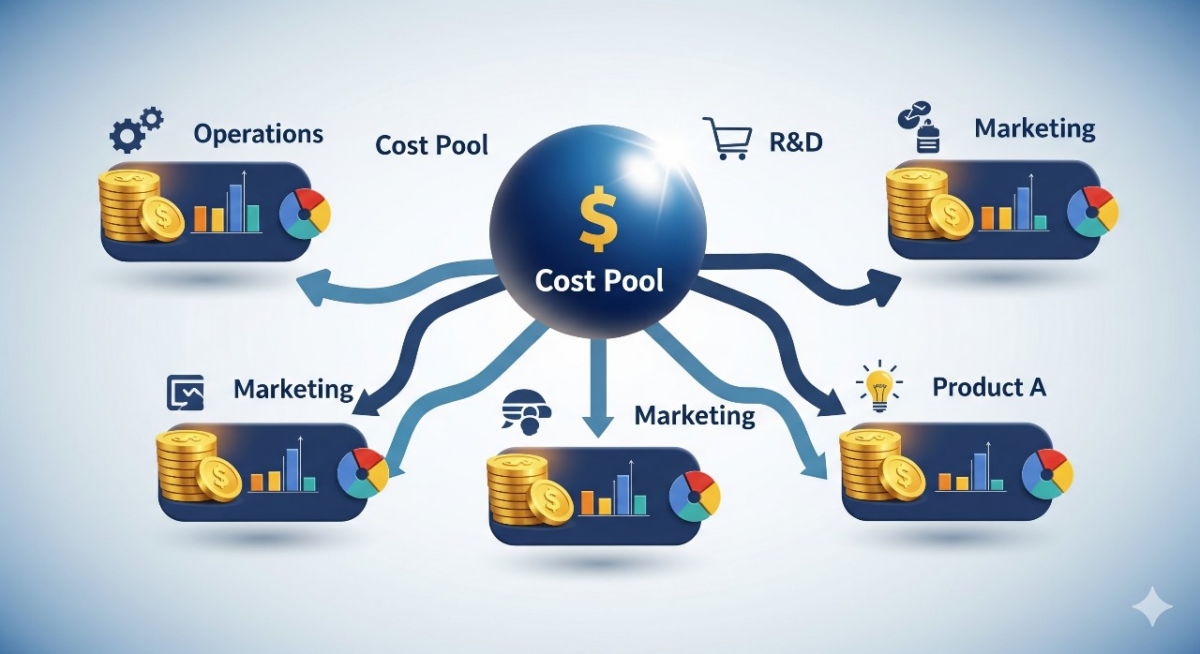
In today’s competitive business environment, accurately managing costs is crucial for long-term success. Every organisation, whether small or large, faces expenses that need to be reasonably assigned across departments, products, or services. This process is known as cost allocation, and it plays a crucial role in budgeting, forecasting, and decision-making.
Without proper allocation, businesses risk underpricing or overpricing their products, misjudging profitability, or mismanaging resources. From manufacturing to service industries, cost allocation ensures that every part of a business gets the right share of expenses.
At Proforecast, we help businesses streamline this process by integrating cost allocation into financial forecasting, allowing leaders to make more intelligent and data-driven decisions.
Table of Contents
1. What is Cost Allocation? (Definition & Simple Explanation)
Cost allocation is the process of distributing costs to different departments, products, projects, or cost centres within a company. It ensures that indirect and shared expenses are assigned reasonably, reflecting the actual cost of operations.
👉 Formal Definition:
Cost allocation is the process of identifying, aggregating, and assigning costs to cost objects, such as departments, products, or services, using appropriate allocation bases.
👉 Simple Example:
Imagine a company has an electricity bill of $10,000. The production department uses 70% of the power, and the administration department uses 30%. Instead of showing the bill as a lump sum, cost allocation divides it into $7,000 for production and $3,000 for administration.
This method provides transparency in accounting, allowing managers to see where money is being spent.
2. Why is Cost Allocation Important?
Cost allocation is more than just an accounting task—it has a direct impact on profitability and financial planning.
Key Reasons It’s Important:
- Fair Distribution of Costs – Ensures that every product or service carries its rightful share of expenses.
- Accurate Profitability Analysis – Helps identify which products, services, or departments are profitable and which are not.
- Improved Budgeting & Forecasting – Supports accurate projections by linking costs to business drivers.
- Decision-Making Tool – Guides management in resource allocation, pricing strategies, and investment planning.
- Compliance – Many industries require cost allocation for financial reporting standards and audits.
👉 Without cost allocation, businesses often rely on guesswork, which can lead to poor decisions.
3. Types of Costs in Cost Allocation
To understand allocation, we must first know the types of costs businesses deal with:
- Direct Costs – Expenses directly tied to a product or service (e.g., raw materials, direct labour).
- Indirect Costs (Overheads) – Shared expenses that cannot be traced to a single output (e.g., rent, utilities, admin salaries).
- Fixed Costs – Costs that remain constant regardless of production levels (e.g., lease payments, insurance).
- Variable Costs – Expenses that vary with production volume (e.g., packaging, shipping).
- Standard Costs – Costs shared across multiple departments (e.g., HR services, IT infrastructure).
- Joint Costs – Costs incurred for multiple products in a single process (e.g., refining crude oil into gasoline and diesel).
Understanding these categories enables businesses to select the most suitable cost allocation methods, ensuring accurate reporting.
4. Types of Cost Allocation Methods
There are several ways to allocate costs, depending on the complexity of the business:
1. Direct Allocation Method
- Costs are directly assigned to departments or products.
- Example: Machine maintenance costs are directly allocated to the production department.
- Simple but not suitable for complex organisations.
2. Step-Down (Sequential) Method
- Costs are allocated sequentially, starting with the service department that provides the most support to others.
- Example: HR costs are allocated first, then IT, then production.
- More accurate than direct allocation.
3. Reciprocal Method
- Recognises mutual services between departments (e.g., HR supports IT, IT supports HR).
- Uses simultaneous equations to allocate costs accurately.
- Best for companies with interdependent service departments.
4. Activity-Based Costing (ABC Method)
- Costs are allocated based on activities that drive expenses.
- Example: A company allocates machine costs based on machine hours or customer support costs based on the number of calls handled.
- Provides the highest accuracy in determining product and service costs.
👉 Activity-based costing has become popular because it aligns costs with actual resource usage.
5. Steps in the Cost Allocation Process
Every company follows a systematic approach to allocating costs:
- Identify Costs – Separate direct and indirect costs.
- Group Costs into Cost Pools – Combine similar expenses (e.g., IT, HR, utilities).
- Choose Allocation Base/Driver – Select a fair basis (labour hours, square footage, machine usage).
- Allocate Costs – Apply the chosen method (direct, step-down, reciprocal, or ABC).
- Review & Analyse Results – Ensure accuracy and adjust methods as needed.
👉 For better understanding, visualise this as a flow chart moving from identification → grouping → allocation → review.
6. Benefits of Cost Allocation
Proper cost allocation brings multiple benefits:
- Accurate Pricing – Helps set fair product or service prices.
- Profitability Insights – Shows which products are profitable.
- Improved Budgeting – Provides a stronger foundation for financial forecasting.
- Efficiency Tracking – Highlights departments or processes with higher costs.
- Fair Resource Distribution – Ensures no department is unfairly charged.
- Compliance – Meets financial reporting requirements and industry standards.
👉 Businesses that master cost allocation gain a competitive edge by making data-backed decisions.
7. Challenges in Cost Allocation
While cost allocation is beneficial, it comes with challenges:
- Selecting the Right Allocation Base – Choosing unfair or irrelevant drivers can distort results.
- Complexity of Methods – Methods like reciprocal allocation require advanced calculations.
- Data Collection Issues – Gathering accurate data is often tricky.
- Manual Errors – Spreadsheets increase the risk of mistakes.
👉 This is why many companies turn to cost allocation software like Proforecast, which automates the process, reduces errors, and saves time.
8. Real-Life Example of Cost Allocation
Manufacturing Example:
A factory producing Product A and Product B has electricity costs of $50,000. Product A uses 60% of machine hours, Product B uses 40%. The price is allocated as $30,000 to Product A and $20,000 to Product B.
Service Industry Example:
A hospital allocates nursing costs to different departments (paediatrics, surgery, and emergency) based on the number of patient hours.
Software Company Example:
A SaaS company allocates server costs across different apps based on storage usage, and marketing costs across services based on revenue contribution.
👉 These examples show how allocation works in different industries.
9. Cost Allocation in Business Forecasting
Cost allocation doesn’t just help with records—it’s vital for the future too.
- Forecasting Profitability – Allocated costs allow companies to project profits by product, service, or department.
- Scenario Planning – Businesses can simulate “what-if” situations (e.g., what if production costs increase by 10%).
- Budget Accuracy – Ensures future budgets align with actual resource usage.
👉 With Proforecast, businesses can run scenario planning and financial forecasting with integrated cost allocation models, giving leaders the confidence to make data-driven decisions.
10. Best Practices for Effective Cost Allocation
- Use relevant allocation bases (machine hours, square footage, etc.).
- Keep cost data updated regularly.
- Apply activity-based costing for higher accuracy.
- Review allocations periodically to match business changes.
- Use automation tools like Proforecast instead of relying only on spreadsheets.
11. How Proforecast Simplifies Cost Allocation
Manually allocating costs can take hours and often leads to errors. Proforecast makes this process effortless by:
- Automating direct and indirect cost allocation.
- Supporting multiple allocation methods (ABC, step-down, reciprocal).
- Integrating cost allocation with forecasting and scenario planning.
- Providing real-time financial insights.
- Eliminating manual spreadsheet errors.
👉 With Proforecast, CFOs, accountants, and business leaders can focus on strategy instead of calculations.
Conclusion
Cost allocation is a cornerstone of management accounting, budgeting, and forecasting. By fairly distributing costs across departments, products, or services, businesses gain transparency, accuracy, and control over financial performance.
From understanding the definition, types, steps, and benefits to recognising challenges and cost allocation, organisations can make smarter decisions.
And while manual methods are time-consuming, tools like Proforecast simplify the process with automation and advanced forecasting features.
FAQ’s:
1. What are the three methods of cost allocation?
The primary methods are:
Direct Method – Assigns costs directly to departments/products.
Step-Down Method – Allocates costs sequentially across departments.
Reciprocal Method – Accounts for mutual services between departments.
👉 Many businesses also use Activity-Based Costing (ABC) for greater accuracy.
2. What is the meaning of the allocation of expenses?
Allocation of expenses refers to distributing shared or indirect costs to various departments, products, or services within a business. For example, rent for a company building can be allocated to other departments based on the space each one uses.
3. What is an example of a price allocation?
A price allocation example would be dividing the cost of a marketing campaign between multiple products. Suppose a company spends $10,000 on digital ads promoting two product lines. If product A generates 70% of ad clicks and Product B 30%, the cost is allocated as $7,000 to Product A and $3,000 to Product B.
4. What does it mean when a cost is allocated?
When a cost is allocated, it means that a shared or indirect expense is assigned to a specific department, product, or project based on a chosen allocation base (e.g., labour hours, square footage, machine usage). It ensures fair distribution of costs across the organisation.
5. What is the easiest method of cost allocation?
The Direct Method is considered the easiest way to allocate costs. It simply assigns expenses to departments or products without considering inter-departmental services. While easy to apply, it may not always provide the most accurate results compared to step-down or reciprocal methods.