Author: Steven Katirai

Top Five Reasons Why Your Business Is Losing Customers

Top Five Reasons Why Your Business Is Losing Customers

Customers are the lifeblood of every business. Without them, no product, service, or marketing strategy can survive for long. Yet, despite being aware of this, many companies still struggle to keep customers engaged and loyal.

The reality is stark: research shows that it costs five to seven times more to acquire a new customer than to retain an existing one, and increasing customer retention rates by just 5% can boost profits by up to 95%. Losing customers isn’t just a hit to revenue—it’s a signal that something deeper is broken in your business model.

But customers rarely leave without reason. They may silently drift away, choose a competitor, or voice their dissatisfaction. The key is identifying the root causes before customer churn spirals out of control.

In this comprehensive guide, we’ll uncover the five most common reasons businesses lose customers. For each one, we’ll dive into:

  • Why it happens
  • The impact on your business
  • Real-world examples and insights
  • Practical steps you can take today

By the end, you’ll have not just an understanding of why customers leave but also a roadmap to keep them coming back.

Reason #1: Poor Customer Experience and Service

Today’s customers expect more than just a product—they expect an experience. If the buying journey feels clunky, frustrating, or impersonal, they won’t hesitate to leave.

Why It Happens

  • Slow responses: Modern customers expect real-time communication. Waiting hours (or days) for replies is a dealbreaker.
  • Inconsistency: Different customers receive wildly different levels of service, creating uncertainty and mistrust.
  • Lack of personalization: Businesses treat all customers the same, rather than tailoring their experiences to meet individual needs.
  • Overloaded teams: Staff without the proper tools or training struggle to meet demand.

The Impact

  • Negative reviews spread online, damaging the brand’s reputation.
  • Decline in repeat purchases and lifetime value.
  • Higher acquisition costs as lost customers need to be replaced.

Real-World Example

A primary telecom provider once ranked at the bottom of customer satisfaction lists due to endless hold times and confusing billing. Competitors that focused on responsive support quickly gained market share, forcing the giant to overhaul its service approach.

How to Fix It

  1. Measure satisfaction: Track Net Promoter Score (NPS), customer satisfaction ratings, and churn rate.
  2. Streamline communication: Utilize chatbots for quick queries and leverage live agents for more complex ones.
  3. Train employees in empathy: Customers don’t just want answers; they want to feel heard and understood.
  4. Create feedback loops: Ask, listen, and act on customer input.

💡 Tip: Even a small business can create loyalty by sending personalized thank-you notes, birthday discounts, or check-in messages after a purchase.

Reason #2: Outdated Products or Services

The world evolves fast. Customers will leave if your offerings fail to meet their changing needs.

Why It Happens

  • Relying too heavily on past successes.
  • Failing to invest in innovation or product updates.
  • Ignoring customer feedback and shifting preferences.
  • Being blindsided by emerging competitors.

The Impact

  • Declining sales as customers move toward newer, better alternatives.
  • Loss of market relevance.
  • Damage to brand reputation as “outdated” or “behind the times.”

Real-World Example

Blockbuster’s collapse is a textbook case. While customers demanded convenient, on-demand streaming, Blockbuster continued to rely on physical rentals. Netflix, in contrast, adapted quickly and became a global leader.

How to Fix It

  1. Monitor market trends: Stay updated on shifts in your industry.
  2. Encourage innovation by dedicating time and resources to research and development (R&D) or service upgrades.
  3. Listen actively: Customer reviews and feedback highlight unmet needs.
  4. Test minor improvements: Pilot new products or features with a subset of customers before rolling them out to the entire user base.

💡 Tip: Even service-based businesses (like salons or restaurants) can innovate—whether it’s offering eco-friendly options, introducing digital booking, or adding new flavors and experiences.

Reason #3: Pricing and Value Misalignment

Customers don’t always leave because prices are high—they leave because they don’t see enough value for what they pay.

Why It Happens

  • Price increases without added benefits.
  • Poor communication of value: customers don’t understand what they’re paying for.
  • Competitors are offering more attractive bundles or deals.
  • Over-discounting, which teaches customers to wait for sales.

The Impact

  • Reduced customer loyalty and increased price sensitivity.
  • Damage to perceived brand value.
  • Profit erosion due to reactive discounting.

Real-World Example

Many gym chains face churn because customers feel membership fees outweigh the benefits. Boutique gyms offering specialized classes at similar or slightly higher prices often win customers by clearly communicating the unique value they bring.

How to Fix It

  1. Know your audience: Segment customers and price based on value, not just cost.
  2. Communicate clearly: Highlight not just features, but outcomes—how your product improves lives.
  3. Review regularly: Pricing should evolve in response to changes in costs, competition, and customer expectations.
  4. Test scenarios: Experiment with bundles, loyalty programs, or tiered pricing.

💡 Tip: Instead of lowering prices, focus on adding extras (extended warranties, better service, exclusive perks) that boost perceived value.

Reason #4: Lack of Trust and Transparency

Trust takes years to build but only seconds to lose. In today’s hyper-connected world, even a single misstep can trigger a wave of customer exits.

Why It Happens

  • Overpromising and underdelivering.
  • Hidden fees or unclear policies.
  • Poor communication during crises (e.g., delays, recalls).
  • Inconsistent service across different touchpoints.

The Impact

  • Loss of credibility and long-term loyalty.
  • Negative publicity amplified through social media.
  • Increased churn and difficulty winning new customers.

Real-World Example

When airlines fail to communicate delays or change policies without notice, customers feel deceived. Competitors that provide proactive updates, even about problems, often retain trust despite challenges.

How to Fix It

  1. Be upfront: Clearly communicate policies, pricing, and timelines.
  2. Admit mistakes: Customers respect businesses that own up to their mistakes and make things right.
  3. Stay consistent: Deliver the same quality across all channels and locations.
  4. Use transparency as a strength: Share processes, sourcing, or behind-the-scenes insights.

💡 Tip: If delays occur, notify customers before they ask. A proactive email or text goes further than a reactive apology.

Reason #5: Poor Planning and Slow Adaptation

In a world of rapid change, businesses that can’t adapt will lose customers to those that can.

Why It Happens

  • Relying on outdated tools (like spreadsheets that can’t keep up).
  • Decisions are made on guesswork instead of data.
  • Leaders are resistant to innovation or change.
  • Lack of scenario planning for crises or shifts in demand.

The Impact

  • Customers are frustrated by delays or outdated practices.
  • Missed opportunities to meet evolving expectations.
  • Decline in market share as competitors move faster.

Real-World Example

During the COVID-19 pandemic, restaurants that quickly pivoted to delivery and online ordering retained customers. Those who waited too long or resisted change lost them permanently.

How to Fix It

  1. Adopt agile planning by using rolling forecasts and short review cycles.
  2. Run scenarios: Prepare for best, worst, and middle-case outcomes.
  3. Invest in technology: Automate processes, centralize data, and analyze trends.
  4. Stay customer-focused: Regularly reassess whether your operations align with customer needs.

💡 Tip: Speed matters. Even if your solution isn’t perfect, showing you’re responsive and adaptive keeps customers engaged.

Practical Action Plan to Retain Customers

Let’s bring it all together. To stop losing customers, businesses should:

  1. Measure what matters: churn rates, NPS, customer lifetime value.
  2. Listen to the voice of the customer: reviews, surveys, and direct feedback.
  3. Invest in data-driven forecasting: anticipate shifts in demand, costs, and resources.
  4. Model different scenarios: prepare for both risks and opportunities.
  5. Communicate with transparency: admit challenges, share solutions, and stay consistent.
  6. Build a customer-centric culture by empowering staff at all levels to prioritize customer needs and concerns.

Conclusion

Customers don’t leave by accident—they leave because their needs aren’t being met. Whether it’s poor service, outdated products, pricing issues, broken trust, or lack of planning, every cause is identifiable and fixable.

The companies that succeed are those that:

  • Anticipate change rather than react to it.
  • Align products and prices with customer value.
  • Maintain transparency and credibility.
  • Empower their teams with insights, not guesswork.

Modern business intelligence and forecasting platforms, such as ProForecast, provide businesses with the clarity to identify risks early, model various futures, and make informed decisions. By doing so, companies not only prevent customer loss—they create stronger, longer-lasting relationships that drive growth.

👉 Want to see how more intelligent forecasting and scenario planning can help your business retain customers and grow with confidence? Book a demo with ProForecast today.

FAQs

1. What are the main reasons businesses lose customers?

The most common reasons are poor customer service, outdated products, pricing/value misalignment, lack of trust, and slow adaptation to change.

2. How can I tell if my business is losing customers?

Watch for signs such as declining repeat sales, reduced engagement, increased complaints, and heightened competitor activity.

3. What’s the fastest way to reduce customer churn?

Improve communication and service immediately—respond faster, resolve complaints quickly, and demonstrate to customers that they’re valued.

4. How important is pricing in customer retention?

Very important, but it’s not just about being cheap. Customers stay when they feel the value matches the price they pay.

5. How can small businesses compete with larger competitors in retaining customers?

By offering personalized service, building trust, staying transparent, and being more agile than bigger companies.

What is a Flash Report and How to Create Them Effectively

What is a Flash Report and How to Create Them Effectively

In the fast-paced business world, having access to real-time data is crucial for making informed decisions. It is where flash reports come in. A flash report is a quick snapshot of a business’s key metrics and performance indicators. It provides decision-makers with the most critical data in a concise, digestible format. The goal of a flash report is to provide an efficient overview of a company’s health, allowing executives and managers to make real-time decisions. In this article, we’ll dive into what flash reports are, how to create them effectively, and the various types that businesses can leverage for better performance tracking.

What is a Flash Report?

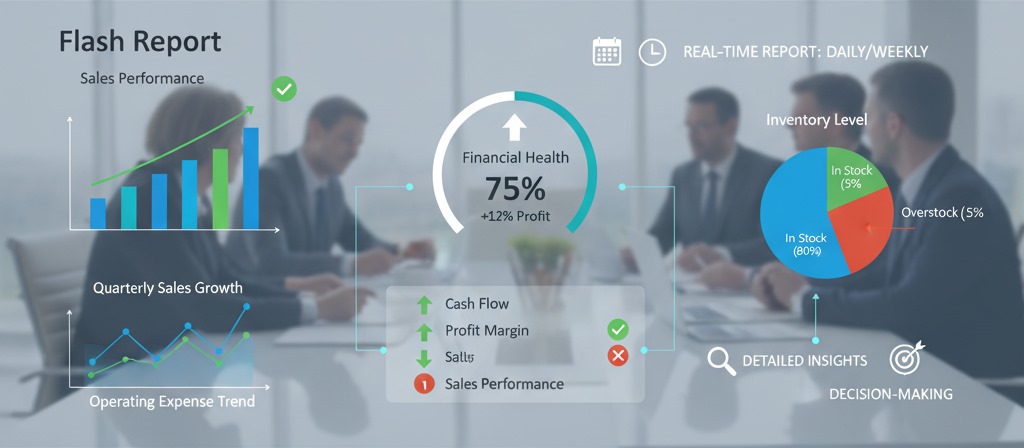
A flash report is a real-time, concise summary of a company’s key metrics and performance indicators. Unlike comprehensive reports that can take days or even weeks to compile, flash reports are typically generated daily or weekly, offering immediate insights into the financial and operational health of a business.

Purpose of a Flash Report

Flash reports are essential tools for monitoring the ongoing performance of a company. They typically include crucial business data such as sales performance, inventory levels, accounts receivable, and profit margins. These reports allow managers and executives to assess the current state of their business quickly and make necessary adjustments in real-time.

The goal is to streamline decision-making by providing a clear and quick view of the most critical metrics, without getting bogged down by unnecessary details.

Proforecast makes it easier to create flash reports with real-time data that can be customized to your specific business needs. Book a demo today and see how we can enhance your reporting process.

Who Receives a Flash Report?

Decision-makers mainly use flash reports within a company. The typical recipients include:

  • Executives: CEOs, CFOs, and other senior leaders rely on flash reports to get a quick overview of the business’s performance, especially when they need to make swift decisions.
  • Managers: Department managers (sales, finance, operations, etc.) use flash reports to monitor their team’s performance against set goals and KPIs.
  • Stakeholders, including investors and shareholders, may also receive flash reports to stay updated on the company’s progress and financial performance.

Why Flash Reports Are Important to Decision Makers

Flash reports give leaders the power to make data-driven decisions on the fly. Whether it’s adjusting sales tactics, addressing inventory issues, or reviewing profit margins, these reports provide critical insights that enable companies to be agile and responsive.

How Flash Reports Are Used in Business

Quick Decision-Making

Flash reports help businesses make quick, informed decisions. For example, a sales manager can immediately see if their team’s performance is on track and, if not, take corrective actions without waiting for a monthly or quarterly report.

Tracking Key Performance Indicators (KPIs)

Flash reports are integral in tracking KPIs across various departments. For instance, finance teams can monitor cash flow, sales teams can assess performance against targets, and inventory managers can keep track of stock levels and reorder points. Tracking these KPIs in real-time allows businesses to stay proactive rather than reactive.

Financial Health Monitoring

A financial flash report can be used to track metrics like profit margins, cash flow, revenue, and expenses. It enables businesses to identify and address any financial issues early, before they escalate.

Operational Efficiency

For companies with complex operations, a flash report can provide insights into operational performance. From production bottlenecks to supply chain issues, a flash report can quickly highlight areas that need attention.

Stakeholder Communication

For public companies or those with external investors, flash reports are a powerful way to keep stakeholders informed. These reports ensure that everyone is aligned with the company’s current performance, helping maintain trust and transparency.

Types of Flash Reports

Flash reports vary depending on the business needs. Here are some common types of flash reports that companies use to track different aspects of their operations:

General Ledger Flash Report

A general ledger flash report provides a summary of financial performance, including expenses, revenue, and profit. This report enables businesses to maintain an up-to-date view of their financial health, allowing them to address any discrepancies or unexpected financial issues promptly.

Sales Flash Report

A sales flash report tracks the performance of sales teams, comparing actual sales to targets or historical performance. This report enables managers to assess the effectiveness of their sales efforts and identify areas where adjustments are necessary. It can also highlight underperforming regions or products.

Inventory Flash Report

An inventory flash report provides a snapshot of stock levels, helping businesses monitor how much inventory is on hand, what’s in transit, and what needs to be restocked. This type of report is crucial for supply chain management, as it helps prevent stockouts or overstocking, thereby ensuring optimal inventory levels.

Accounts Receivable Flash Report

For companies managing customer payments, an accounts receivable flash report highlights outstanding invoices, overdue payments, and collections performance. It helps businesses keep track of cash flow and take proactive measures to address overdue accounts.

Manufacturing Flash Report (PMI)

A manufacturing flash report is used to track production levels, operational status, and any challenges in the manufacturing process. It provides managers with insights into production bottlenecks, worker productivity, and other operational factors that may need attention.

How to Prepare a Flash Report

Creating a flash report that is both effective and easy to understand requires careful planning and execution. Here’s how you can prepare one effectively:

1. Identify Key Metrics

The first step in creating a flash report is identifying the key metrics that need to be tracked. These metrics will vary depending on your industry, but typically, businesses will want to include financial, sales, and operational data.

For example, your flash report might include:

  • Sales Performance: Daily or weekly sales numbers compared to targets.
  • Profitability: Metrics such as gross margin, operating profit, and net income.
  • Inventory Levels: Tracking critical inventory items and reorder points.

2. Gather Data

Once you know which metrics to track, you’ll need to gather the relevant data. This data may originate from various sources, including accounting software (such as QuickBooks or Xero), ERP systems, or manually entered data. It’s essential to ensure that the data is up-to-date, accurate, and consistent.

3. Keep It Concise

A flash report is meant to provide a quick snapshot, so it should be brief and to the point. Avoid overloading the report with unnecessary details. Focus on the most critical data points that will help decision-makers take action quickly.

4. Visual Representation

To make the data more digestible, use charts, graphs, and tables. Visuals help to quickly convey complex information, making it easier for managers to grasp trends and issues at a glance.

5. Ensure Data Integrity

The accuracy of the data in your flash report is paramount. Ensure that all figures are double-checked and that the data comes from reliable sources. Incorrect or outdated data can lead to poor decisions and financial errors.

With Proforecast, you can automate data collection and ensure accurate reporting. Book a demo to see how we can help streamline your report preparation

Common Mistakes in Flash Reports

Even the best flash reports can fall short if not adequately prepared. Here are some common mistakes to watch out for:

Inaccurate or Missing Data

Missing or inaccurate data can render a flash report useless. Double-check all figures to ensure their accuracy and make sure no key metrics are left out.

Delays in Reporting

If your flash report isn’t delivered on time, it loses its value. Flash reports should be generated and shared in real-time or near-real-time to provide actionable insights.

Overly Complicated Visuals

While charts and graphs are helpful, overly complicated visuals can confuse readers. Keep your visuals intuitive and straightforward, focusing on clarity rather than design.

Failure to Tailor Reports to Audience

A flash report should be customised for its audience. Senior executives may need a high-level overview, while department managers may require more detailed data. Tailor your report to the needs of the specific recipients.

Tips for Creating Reliable Flash Reports

Here are a few tips to help you create reliable flash reports that provide actual value to your organisation:

1. Keep It Under One Hour

A flash report should be quick to create. If it takes more than an hour to prepare, you’re likely overcomplicating the process. Use automation tools to gather and process data faster.

2. Focus on Clear and Simple Visuals

Simplicity is key. Use clear charts and graphs that make the data easy to understand at a glance. The goal is to provide information quickly, not overwhelm your audience.

3. Personalise Without Losing Consistency

Tailor your flash report to the audience’s needs, but maintain a consistent structure. Having a standardised format ensures that reports are easy to read, no matter who receives them.

Qualities of a Strong Flash Report

A strong flash report should have the following qualities:

  • Clarity: The report should be easy to understand without requiring a lot of explanation.
  • Relevance: It should only include the most critical and relevant data for decision-making.
  • Accuracy: Data should be correct and reliable to avoid making decisions based on false information.
  • Timeliness: Flash reports should be generated quickly and shared without delay.
  • Actionable Insights: The report should highlight issues that require immediate attention, enabling decision-makers to take prompt action.

Key Metrics to Include in Your Flash Reports

A solid flash report should track the key metrics that are most important to your business. These may include:

  • Financial Metrics: Profit margins, cash flow, revenue.
  • Sales Metrics: Sales performance, conversion rates, average deal size.
  • Operational Metrics: Inventory levels, production progress, order fulfilment.
  • Performance Metrics: KPI progress, goal achievement, project milestones.

Benefits of Using Flash Reports

There are several benefits to using flash reports in your business:

  • Quick Decision-Making: Enables leaders to make informed decisions on the spot.
  • Increased Efficiency: Reduces time spent gathering and analysing data.
  • Enhanced Collaboration: Keeps teams aligned with real-time data and insights.

Conclusion

In conclusion, flash reports are powerful tools that provide quick, actionable insights into a company’s performance. By focusing on key metrics and delivering timely, accurate information, flash reports enable businesses to make real-time decisions and stay agile in a rapidly changing business environment. Whether you’re tracking sales, inventory, or financial health, creating effective flash reports will help you maintain control over your company’s performance and drive better results.

Management Accounting and Its Role in Supporting Operational Decisions

Management Accounting and Its Role in Supporting Operational Decisions

In today’s fast-paced business world, every decision can impact profitability, growth, and long-term success. From deciding how much inventory to stock to determining whether to expand into a new market, operational decisions are at the heart of running a business smoothly. But how do managers and leaders make the right calls? The answer lies in management accounting.

Unlike financial accounting, which focuses on reporting past performance, management accounting is all about looking forward. It provides the insights, data, and analysis needed to guide everyday operations and strategic moves. In short, management accounting turns raw numbers into practical business intelligence.

This article explores what management accounting is, why it matters, the tools and techniques it uses, and how it supports operational decision-making. By the end, you’ll see why no growing business can afford to overlook this powerful discipline.

What is Management Accounting?

At its core, management accounting (also known as managerial accounting) is the practice of analysing financial and non-financial data to support decision-making within an organisation. Unlike financial accounting, which prepares reports for external stakeholders, such as investors or regulators, management accounting is focused entirely on internal use.

Key objectives of management accounting include:

  • Cost control: Identifying areas where resources are wasted.
  • Planning and forecasting: Helping managers set realistic goals and predict outcomes.
  • Performance measurement: Evaluating efficiency, productivity, and profitability.
  • Decision-making: Supplying accurate information to make informed operational and strategic choices.

In simple terms, management accounting is less about “what happened” and more about “what should we do next?”

The Role of Management Accounting in Operational Decision-Making

Operational decisions are the choices managers make daily to ensure smooth business functioning. These include questions like:

  • How much inventory should we hold this month?
  • Should we outsource production or keep it in-house?
  • What price should we set for a new product?
  • Which marketing campaign gives us the best return?

Management accounting plays a critical role in these decisions by providing:

  • Relevant data: Not just financial figures, but insights on processes, resources, and performance.
  • Forward-looking analysis: Tools like forecasting and budgeting help predict future outcomes.
  • Risk assessment: Evaluating potential challenges before making a move.
  • Operational alignment: Ensuring decisions align with broader business strategy.

For example, a manufacturing company may use management accounting to analyse the cost of producing goods in-house versus outsourcing. The decision is not just about cost—it also involves delivery times, quality, and risk. Management accounting provides the complete picture needed to make informed choices.

Key Techniques and Tools of Management Accounting

Management accounting uses a variety of tools and techniques to turn complex data into actionable insights. Let’s explore the most important ones.

Cost Analysis and Control

Cost analysis identifies where money is being spent and whether it delivers value. By studying cost drivers, businesses can reduce waste, optimise processes, and improve margins. For example, a restaurant chain might discover that food waste is eating into profits and implement stricter inventory controls to reduce costs.

Budgeting and Forecasting

Budgeting creates a roadmap for business operations, while forecasting predicts future financial outcomes. Together, they help managers allocate resources wisely and prepare for potential risks. For instance, during seasonal demand shifts, a retail company can forecast sales and adjust staffing levels to avoid overspending.

Performance Measurement

Management accountants use Key Performance Indicators (KPIs), variance analysis, and balanced scorecards to evaluate how well the business is performing. It enables managers to identify problems and take corrective action quickly. For example, if sales targets are missed, performance measurement can reveal whether the issue lies in pricing, customer demand, or marketing effectiveness.

Product and Service Profitability Analysis

Not all products or services contribute equally to profits. Management accounting helps identify which offerings are most profitable and which may need to be discontinued. For example, a software company might find that a legacy product consumes high maintenance costs but contributes little to revenue, leading to a decision to phase it out.

Investment Appraisal

Major decisions, such as purchasing new equipment or launching a new product, require investment appraisal. Tools such as Net Present Value (NPV), Internal Rate of Return (IRR), and payback period are used to evaluate whether an investment will generate sufficient returns.

Cash Flow and Working Capital Analysis

Cash is the lifeblood of any business. Management accounting ensures that companies maintain healthy cash flow by monitoring receivables, payables, and inventory. For example, a company may use cash flow analysis to decide whether it can afford to extend credit terms to customers without straining operations.

Types of Management Accounting Approaches

Management accounting isn’t one-size-fits-all. Businesses apply different approaches depending on their needs.

Product Costing and Valuation

Determining the actual cost of producing goods or services helps in setting competitive yet profitable prices.

Inventory and Stock Control Analysis

Avoiding excess inventory reduces storage costs, while preventing shortages ensures smooth operations. This balance is crucial in industries such as retail and manufacturing.

Trend and Variance Analysis

By studying past data, businesses can identify trends that guide future actions. Variance analysis compares actual performance against planned targets to highlight deviations.

Decision-Making Models

Classic decision-making models include make-or-buy analysis, pricing strategies, and break-even analysis, all of which help businesses make operational choices with confidence.

Benefits of Management Accounting in Operational Decisions

Adopting management accounting brings a wide range of benefits, especially when it comes to operational decisions:

  • Cost efficiency: Identifying and eliminating unnecessary expenses.
  • Improved resource allocation: Ensuring money, people, and materials are used where they add the most value.
  • Risk management: Spotting potential issues before they become costly problems.
  • Agility and adaptability: Enabling quicker responses to market changes.
  • Evidence-based decision-making: Moving away from gut feelings to data-backed choices.
  • Sustainable growth: Supporting long-term strategies with reliable insights.

In short, management accounting transforms guesswork into informed, confident decision-making.

Management Accounting vs Financial Accounting

Although they share similarities, management accounting and financial accounting serve very different purposes.

  • Financial Accounting:
    • Past-focused.
    • Prepares standardised reports for external stakeholders.
    • Heavily regulated and compliance-driven.
  • Management Accounting:
    • Future-focused.
    • Provides customised reports for internal use.
    • Flexible and designed to support decision-making.

Think of financial accounting as the rear-view mirror, while management accounting is the GPS that guides you forward. Both are important, but only management accounting enables managers to make informed operational choices daily.

Challenges in Using Management Accounting for Operations

While powerful, management accounting isn’t without its challenges:

  • Data accuracy: Decisions are only as good as the data provided. Incomplete or incorrect information can lead to costly mistakes.
  • Integration with technology: Many businesses still rely on outdated systems that don’t support real-time data analysis.
  • Skill gaps: Management accounting requires professionals with strong analytical, financial, and strategic skills.
  • Implementation costs: Small businesses may find it expensive to adopt sophisticated management accounting systems.

Overcoming these challenges often requires investment in technology, training, and process improvements.

Future of Management Accounting in Decision-Making

The field of management accounting is evolving rapidly with technology. Emerging trends include:

  • Artificial Intelligence (AI) and Automation: Automating repetitive tasks and providing predictive insights.
  • Big Data Analytics: Using large datasets to identify patterns and forecast outcomes.
  • Cloud-Based Tools: Allowing real-time access to management reports from anywhere.
  • Sustainability Reporting: Integrating environmental and social metrics into decision-making.

As businesses face increasing complexity, management accounting will become even more essential for navigating uncertainty and staying competitive.

Conclusion

Management accounting is far more than just crunching numbers—it’s about empowering businesses to make smarter decisions every day. From controlling costs and forecasting future trends to evaluating investments and improving efficiency, management accounting is at the heart of operational success.

By leveraging its tools and insights, businesses can move from reactive problem-solving to proactive decision-making, ensuring sustainable growth in an unpredictable world.

For managers, entrepreneurs, and decision-makers, the message is clear: management accounting isn’t optional—it’s essential.

FAQ’s:

1. What is management accounting in simple terms?

Management accounting is the process of analysing financial and non-financial data to help managers make better business decisions.

2. How does management accounting support operational decisions?

It provides insights through cost analysis, budgeting, forecasting, and performance evaluation, guiding managers in daily and strategic choices.

3. What are some standard tools of management accounting?

Key tools include budgeting, variance analysis, profitability analysis, investment appraisal, and cash flow forecasting.

4. How is management accounting different from financial accounting?

Financial accounting looks at past performance for external reporting, while management accounting is future-focused and supports internal decision-making.

5. Why is management accounting important for businesses today?

It helps reduce costs, improve efficiency, manage risks, and make data-driven decisions that ensure sustainable growth.

Cost Allocation – Definition, Types, Steps, Benefits

Cost Allocation – Definition, Types, Steps, Benefits

In today’s competitive business environment, accurately managing costs is crucial for long-term success. Every organisation, whether small or large, faces expenses that need to be reasonably assigned across departments, products, or services. This process is known as cost allocation, and it plays a crucial role in budgeting, forecasting, and decision-making.

Without proper allocation, businesses risk underpricing or overpricing their products, misjudging profitability, or mismanaging resources. From manufacturing to service industries, cost allocation ensures that every part of a business gets the right share of expenses.

At Proforecast, we help businesses streamline this process by integrating cost allocation into financial forecasting, allowing leaders to make more intelligent and data-driven decisions.

1. What is Cost Allocation? (Definition & Simple Explanation)

Cost allocation is the process of distributing costs to different departments, products, projects, or cost centres within a company. It ensures that indirect and shared expenses are assigned reasonably, reflecting the actual cost of operations.

👉 Formal Definition:

Cost allocation is the process of identifying, aggregating, and assigning costs to cost objects, such as departments, products, or services, using appropriate allocation bases.

👉 Simple Example:

Imagine a company has an electricity bill of $10,000. The production department uses 70% of the power, and the administration department uses 30%. Instead of showing the bill as a lump sum, cost allocation divides it into $7,000 for production and $3,000 for administration.

This method provides transparency in accounting, allowing managers to see where money is being spent.

2. Why is Cost Allocation Important?

Cost allocation is more than just an accounting task—it has a direct impact on profitability and financial planning.

Key Reasons It’s Important:

  1. Fair Distribution of Costs – Ensures that every product or service carries its rightful share of expenses.
  2. Accurate Profitability Analysis – Helps identify which products, services, or departments are profitable and which are not.
  3. Improved Budgeting & Forecasting – Supports accurate projections by linking costs to business drivers.
  4. Decision-Making Tool – Guides management in resource allocation, pricing strategies, and investment planning.
  5. Compliance – Many industries require cost allocation for financial reporting standards and audits.

👉 Without cost allocation, businesses often rely on guesswork, which can lead to poor decisions.

3. Types of Costs in Cost Allocation

To understand allocation, we must first know the types of costs businesses deal with:

  1. Direct Costs – Expenses directly tied to a product or service (e.g., raw materials, direct labour).
  2. Indirect Costs (Overheads) – Shared expenses that cannot be traced to a single output (e.g., rent, utilities, admin salaries).
  3. Fixed Costs – Costs that remain constant regardless of production levels (e.g., lease payments, insurance).
  4. Variable Costs – Expenses that vary with production volume (e.g., packaging, shipping).
  5. Standard Costs – Costs shared across multiple departments (e.g., HR services, IT infrastructure).
  6. Joint Costs – Costs incurred for multiple products in a single process (e.g., refining crude oil into gasoline and diesel).

Understanding these categories enables businesses to select the most suitable cost allocation methods, ensuring accurate reporting.

4. Types of Cost Allocation Methods

There are several ways to allocate costs, depending on the complexity of the business:

1. Direct Allocation Method

  • Costs are directly assigned to departments or products.
  • Example: Machine maintenance costs are directly allocated to the production department.
  • Simple but not suitable for complex organisations.

2. Step-Down (Sequential) Method

  • Costs are allocated sequentially, starting with the service department that provides the most support to others.
  • Example: HR costs are allocated first, then IT, then production.
  • More accurate than direct allocation.

3. Reciprocal Method

  • Recognises mutual services between departments (e.g., HR supports IT, IT supports HR).
  • Uses simultaneous equations to allocate costs accurately.
  • Best for companies with interdependent service departments.

4. Activity-Based Costing (ABC Method)

  • Costs are allocated based on activities that drive expenses.
  • Example: A company allocates machine costs based on machine hours or customer support costs based on the number of calls handled.
  • Provides the highest accuracy in determining product and service costs.

👉 Activity-based costing has become popular because it aligns costs with actual resource usage.

5. Steps in the Cost Allocation Process

Every company follows a systematic approach to allocating costs:

  1. Identify Costs – Separate direct and indirect costs.
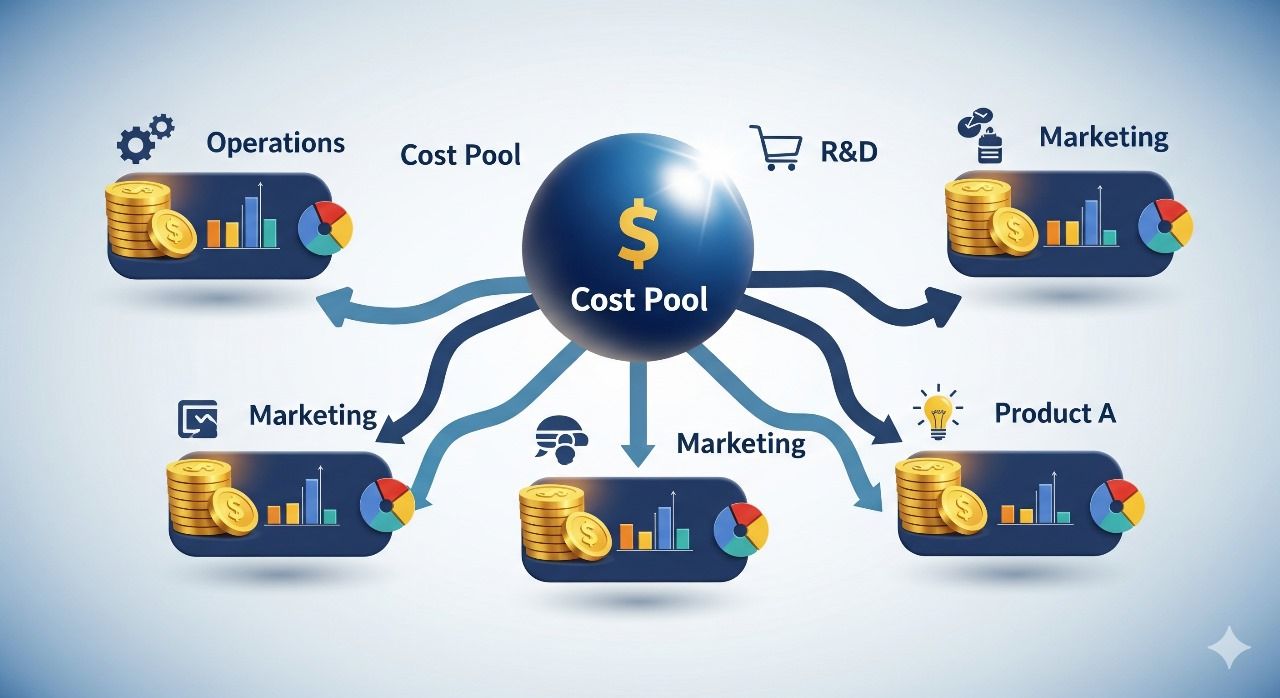
  2. Group Costs into Cost Pools – Combine similar expenses (e.g., IT, HR, utilities).
  3. Choose Allocation Base/Driver – Select a fair basis (labour hours, square footage, machine usage).
  4. Allocate Costs – Apply the chosen method (direct, step-down, reciprocal, or ABC).
  5. Review & Analyse Results – Ensure accuracy and adjust methods as needed.

👉 For better understanding, visualise this as a flow chart moving from identification → grouping → allocation → review.

6. Benefits of Cost Allocation

Proper cost allocation brings multiple benefits:

  • Accurate Pricing – Helps set fair product or service prices.
  • Profitability Insights – Shows which products are profitable.
  • Improved Budgeting – Provides a stronger foundation for financial forecasting.
  • Efficiency Tracking – Highlights departments or processes with higher costs.
  • Fair Resource Distribution – Ensures no department is unfairly charged.
  • Compliance – Meets financial reporting requirements and industry standards.

👉 Businesses that master cost allocation gain a competitive edge by making data-backed decisions.

7. Challenges in Cost Allocation

While cost allocation is beneficial, it comes with challenges:

  • Selecting the Right Allocation Base – Choosing unfair or irrelevant drivers can distort results.
  • Complexity of Methods – Methods like reciprocal allocation require advanced calculations.
  • Data Collection Issues – Gathering accurate data is often tricky.
  • Manual Errors – Spreadsheets increase the risk of mistakes.

👉 This is why many companies turn to cost allocation software like Proforecast, which automates the process, reduces errors, and saves time.

8. Real-Life Example of Cost Allocation

Manufacturing Example:

A factory producing Product A and Product B has electricity costs of $50,000. Product A uses 60% of machine hours, Product B uses 40%. The price is allocated as $30,000 to Product A and $20,000 to Product B.

Service Industry Example:

A hospital allocates nursing costs to different departments (paediatrics, surgery, and emergency) based on the number of patient hours.

Software Company Example:

A SaaS company allocates server costs across different apps based on storage usage, and marketing costs across services based on revenue contribution.

👉 These examples show how allocation works in different industries.

9. Cost Allocation in Business Forecasting

Cost allocation doesn’t just help with records—it’s vital for the future too.

  • Forecasting Profitability – Allocated costs allow companies to project profits by product, service, or department.
  • Scenario Planning – Businesses can simulate “what-if” situations (e.g., what if production costs increase by 10%).
  • Budget Accuracy – Ensures future budgets align with actual resource usage.

👉 With Proforecast, businesses can run scenario planning and financial forecasting with integrated cost allocation models, giving leaders the confidence to make data-driven decisions.

10. Best Practices for Effective Cost Allocation

  1. Use relevant allocation bases (machine hours, square footage, etc.).
  2. Keep cost data updated regularly.
  3. Apply activity-based costing for higher accuracy.
  4. Review allocations periodically to match business changes.
  5. Use automation tools like Proforecast instead of relying only on spreadsheets.

11. How Proforecast Simplifies Cost Allocation

Manually allocating costs can take hours and often leads to errors. Proforecast makes this process effortless by:

  • Automating direct and indirect cost allocation.
  • Supporting multiple allocation methods (ABC, step-down, reciprocal).
  • Integrating cost allocation with forecasting and scenario planning.
  • Providing real-time financial insights.
  • Eliminating manual spreadsheet errors.

👉 With Proforecast, CFOs, accountants, and business leaders can focus on strategy instead of calculations.

Conclusion

Cost allocation is a cornerstone of management accounting, budgeting, and forecasting. By fairly distributing costs across departments, products, or services, businesses gain transparency, accuracy, and control over financial performance.

From understanding the definition, types, steps, and benefits to recognising challenges and cost allocation, organisations can make smarter decisions.

And while manual methods are time-consuming, tools like Proforecast simplify the process with automation and advanced forecasting features.

FAQ’s:

1. What are the three methods of cost allocation?

The primary methods are:

Direct Method – Assigns costs directly to departments/products.

Step-Down Method – Allocates costs sequentially across departments.

Reciprocal Method – Accounts for mutual services between departments.

👉 Many businesses also use Activity-Based Costing (ABC) for greater accuracy.

2. What is the meaning of the allocation of expenses?

Allocation of expenses refers to distributing shared or indirect costs to various departments, products, or services within a business. For example, rent for a company building can be allocated to other departments based on the space each one uses.

3. What is an example of a price allocation?

A price allocation example would be dividing the cost of a marketing campaign between multiple products. Suppose a company spends $10,000 on digital ads promoting two product lines. If product A generates 70% of ad clicks and Product B 30%, the cost is allocated as $7,000 to Product A and $3,000 to Product B.

4. What does it mean when a cost is allocated?

When a cost is allocated, it means that a shared or indirect expense is assigned to a specific department, product, or project based on a chosen allocation base (e.g., labour hours, square footage, machine usage). It ensures fair distribution of costs across the organisation.

5. What is the easiest method of cost allocation?

The Direct Method is considered the easiest way to allocate costs. It simply assigns expenses to departments or products without considering inter-departmental services. While easy to apply, it may not always provide the most accurate results compared to step-down or reciprocal methods.

What to Look Out for When Using AI in Financial Reporting

What to Look Out for When Using AI in Financial Reporting

In today’s fast-paced financial world, Artificial Intelligence (AI) has revolutionised many industries, with financial reporting being one of the most impacted areas. By leveraging AI, companies can streamline their reporting processes, reduce errors, and improve decision-making. However, while AI offers significant benefits, it also brings new challenges that must be understood and managed effectively.

In this article, we’ll explore what you need to look out for when using AI in financial reporting, the benefits it offers, common pitfalls, best practices for implementation, and future trends. Whether you’re a financial professional or a company looking to integrate AI into your processes, this guide will provide valuable insights.

How AI is Transforming Financial Reporting

AI is transforming the way financial reports are generated, analysed, and acted upon. Financial reporting, which was once a manual, error-prone process, is now becoming faster, more accurate, and more insightful. AI allows for the automation of data entry, report generation, and analysis, saving valuable time and reducing human error.

AI-powered tools can handle vast amounts of financial data that would be overwhelming for human teams to process manually. These tools can extract data from various sources, analyse it, and generate detailed reports in real-time. It not only makes the reporting process faster but also provides more accurate insights, which can lead to better financial decisions.

For example, AI can automatically classify financial transactions, create balance sheets, generate income statements, and even predict future cash flow. This level of automation reduces the risk of human errors. It allows finance teams to focus on higher-value tasks, such as analysing the data and making strategic decisions.

Key Benefits of Using AI in Financial Reporting

Faster Data Processing and Reporting

One of the most significant advantages of using AI in financial reporting is the speed at which data can be processed and reports can be generated. Traditional financial reporting often involves manually sifting through large datasets, which is time-consuming and prone to errors. AI tools, on the other hand, can process vast amounts of financial data in a fraction of the time, delivering reports much faster.

AI can also provide real-time financial insights, allowing businesses to make quicker decisions. For instance, if a company is tracking cash flow, AI can instantly analyse incoming and outgoing transactions, giving managers an up-to-date view of the company’s financial health.

Improved Accuracy and Reduced Errors

Manual financial reporting is susceptible to human error, which can have serious consequences, especially in complex financial statements. AI, however, eliminates these errors by automating repetitive tasks and adhering to predefined rules and algorithms. By minimising the risk of mistakes, AI ensures that the financial reports generated are more accurate and reliable.

Furthermore, AI algorithms can learn from historical data, improving their accuracy over time. It means that as the system is used more, it will become better at identifying trends, anomalies, and patterns, offering deeper insights and more precise financial predictions.

Enhanced Regulatory Compliance and Risk Management

Compliance with financial regulations is an ongoing challenge for businesses, especially in the face of evolving laws and requirements. AI can help automate compliance reporting, ensuring that reports are generated in accordance with the latest regulatory standards. It not only saves time but also reduces the risk of non-compliance, which can result in fines and legal issues.

In addition, AI can assist in financial risk management. By analysing historical data and market conditions, AI can identify potential risks and provide businesses with early warnings. For example, AI can be used to detect unusual spending patterns or flag discrepancies in financial data, which could indicate fraud or errors in reporting.

Common Challenges When Implementing AI in Financial Reporting

While AI offers numerous benefits, its implementation in financial reporting comes with specific challenges. Understanding these challenges and how to address them is crucial for ensuring the successful adoption of AI.

AI Hallucinations: What They Are and How to Address Them

One of the most significant challenges of AI in financial reporting is the risk of “hallucinations” – when AI models generate false or misleading data. AI hallucinations occur when the machine learning model incorrectly interprets data, resulting in inaccurate financial reports.

These errors can be particularly problematic in finance, where even small mistakes can have significant implications. For example, if an AI system incorrectly reports revenue or expenses, it could lead to faulty financial statements, affecting decision-making and potentially violating regulatory standards.

To address this issue, it’s essential to monitor and refine AI models continuously. Regular audits, human oversight, and feedback loops can help catch errors before they become significant problems. Additionally, training AI models on high-quality, accurate data can reduce the likelihood of hallucinations.

Inconsistent Results Across Teams

Another challenge of using AI in financial reporting is the potential for inconsistency in results across different teams. AI models may produce different outputs depending on the data inputs, settings, or even the individual users interacting with the system. This can lead to discrepancies in reports, making it difficult for finance teams to trust the AI-generated data.

To mitigate this risk, companies should standardise their AI models and ensure that all team members are using the same settings and data sources. Establishing clear protocols for how AI should be used helps maintain consistency across teams.

Repeatability in AI-driven Reports

For AI to be truly effective in financial reporting, it must be able to produce repeatable results. Financial reports must be consistent over time, particularly when used for forecasting and budgeting. However, many AI systems struggle to make consistent outputs, especially when trained on incomplete or biased data.

Ensuring repeatability requires rigorous testing and validation of AI models. Finance teams should regularly review AI-generated reports and conduct thorough testing to ensure that the system is delivering consistent and reliable results. This process should be part of an ongoing cycle of improvement and refinement.

Key Use Cases of AI in Financial Reporting

AI has many applications in financial reporting, and its versatility is one of the key reasons for its growing popularity. Below are some of the primary use cases for AI in this field.

Real-time Financial Reporting and Analysis

AI can automate the process of tracking financial data in real-time, providing businesses with instant access to up-to-date financial reports. For example, AI-powered tools can monitor daily transactions, update balance sheets, and track cash flow in real-time, allowing managers to make quicker decisions and respond to financial issues as they arise.

Real-time financial reporting also helps businesses identify trends and anomalies faster. It can be beneficial for detecting early signs of economic distress or uncovering opportunities for growth.

Fraud Detection and Internal Audits

AI is becoming an invaluable tool for internal audits and fraud detection. By analysing transaction data and identifying unusual patterns, AI can detect potential fraud or errors in financial reporting. For example, AI can flag suspicious transactions or highlight inconsistencies in account balances, prompting auditors to investigate further.

It can help companies save time and money by automating the audit process and identifying risks early on. Additionally, AI can improve the accuracy of audits by minimising human error.

Financial Forecasting and Budgeting

AI plays a crucial role in financial forecasting and budgeting. By analysing historical data, market conditions, and other relevant factors, AI can generate accurate forecasts for revenue, expenses, and cash flow. It helps businesses plan for the future and make more informed financial decisions.

AI can also support dynamic budgeting, where budgets are continuously adjusted based on changing circumstances. This level of flexibility allows companies to respond quickly to market changes and ensure that resources are allocated efficiently.

How to Implement AI in Your Financial Reporting Processes

Implementing AI in financial reporting requires careful planning and execution. Here are the key steps for successful implementation:

Assess Financial Reporting Needs

Before implementing AI, it’s essential to assess your current financial reporting processes and identify areas where AI could add value. It may include automating repetitive tasks, improving data accuracy, or generating real-time reports. By understanding where AI can make the most impact, you can prioritise its implementation effectively.

Choose the Right Tools

There are many AI-powered tools available for financial reporting, and choosing the right one is critical. Look for tools that integrate with your existing systems and can handle the specific needs of your organisation. Whether it’s a cloud-based AI tool or an on-premise solution, ensure that the software aligns with your business goals and objectives.

Train Your Team

For AI to be successful, your team needs to be trained to use it effectively. It includes understanding how AI can assist in reporting, how to interpret AI-generated results, and how to troubleshoot issues. Proper training ensures that your team can fully leverage the power of AI without encountering common pitfalls.

Risk-Benefit Analysis of AI in Financial Reporting

When adopting AI in financial reporting, it’s essential to weigh the risks and benefits. On the positive side, AI can increase efficiency, reduce errors, and provide valuable insights. However, there are potential risks, such as data security issues, over-reliance on AI, and the need for ongoing maintenance and monitoring.

By conducting a thorough risk-benefit analysis, companies can make informed decisions about how to incorporate AI into their financial reporting processes while minimising potential risks.

Best Practices for Maximising AI in Financial Reporting

To get the most out of AI, it’s essential to follow best practices that ensure successful implementation and long-term value. Some of these include:

Continuous Improvement and Feedback Loops

AI models should be continuously updated and refined based on new data and feedback. Regular audits and reviews ensure that AI systems are working as intended and can adapt to changing circumstances.

Building Trust in AI-generated Reports

Although AI can automate financial reporting, human oversight is still necessary. Ensuring that finance professionals review AI-generated reports builds trust in the system. It ensures that any discrepancies or issues are identified quickly.

Final Thoughts: The Future of AI in Financial Reporting

The future of AI in financial reporting is bright. As technology continues to evolve, AI will become even more powerful, offering deeper insights, better forecasting, and more precise reporting. However, businesses must be aware of the challenges that come with AI adoption and implement strategies to address them effectively.

By understanding the benefits, risks, and best practices for AI in financial reporting, companies can harness the power of AI to drive economic success in an increasingly data-driven world.

Frequently Asked Questions (FAQs)

1. What is AI in financial reporting?

AI in financial reporting refers to the use of artificial intelligence technologies to automate and enhance financial data processing, reporting, and analysis. It helps businesses generate more accurate, faster, and real-time financial reports while reducing human errors.

2. How can AI improve financial reporting accuracy?

AI improves accuracy by automating data entry and analysis, ensuring that financial reports are free from human errors. AI algorithms also learn from historical data, making them more precise over time.

3. What are the risks of using AI in financial reporting?

Some risks include AI-generated errors (hallucinations), inconsistent results, over-reliance on automated processes, and data security concerns. Continuous monitoring and human oversight can help mitigate these risks.

4. Can AI be used for financial forecasting?

Yes, AI is widely used for financial forecasting. It analyses historical data and current market trends to generate accurate predictions for revenue, expenses, and cash flow.

5. How can I implement AI in my financial reporting?

To implement AI, first assess your current processes to identify areas for improvement. Then, please choose the right AI tools and train your team to use them effectively. Regular audits and feedback loops will help ensure successful integration.

5 Key FP&A Trends for 2025

5 Key FP&A Trends for 2025

Financial Planning & Analysis (FP&A) has long been the backbone of business decision-making, ensuring that organisations make informed financial decisions. However, as we move into 2025, FP&A is evolving rapidly. With technology driving change across industries, financial teams need to stay ahead of emerging trends to optimise business performance. In this blog, we’ll explore the five key FP&A trends for 2025, providing insights into how these changes will impact the future of finance and how businesses can adapt to these trends.

Introduction to FP&A in 2025

FP&A has always been integral to financial health. Still, the function is transforming from a back-office reporting role to a strategic partner. As businesses are forced to become more agile in a constantly shifting landscape, the role of FP&A has expanded beyond traditional budgeting and forecasting. Today, financial professionals are required to make quicker, more informed decisions. In 2025, FP&A will be more aligned with business strategy, helping organisations adapt to rapid changes and capitalise on new opportunities.

As FP&A professionals embrace the latest trends, they will be better equipped to manage risk, optimise business performance, and maintain profitability in a highly competitive environment. To help businesses stay ahead, we’ll examine five key FP&A trends for 2025.

1. Business Planning Within BI Platforms

In 2025, business planning will no longer be siloed in spreadsheets or standalone financial software. Instead, financial planning and analysis will be integrated into Business Intelligence (BI) platforms. BI tools like Microsoft Power BI, Tableau, and Qlik are evolving into platforms where organisations can manage both operational and financial performance simultaneously.

How BI Improves Planning

  • Real-Time Insights: BI platforms provide real-time analytics, which means financial teams can access up-to-date data when they need it most. It empowers FP&A professionals to make informed decisions and adapt quickly to market changes, rather than relying on outdated information.
  • Seamless Integration: By bringing financial data into BI platforms, FP&A professionals can easily merge financial plans with business operations. This integration provides a holistic view of the business, ensuring that both departments (finance and operations) are aligned on goals and performance metrics.
  • Collaborative Features: BI platforms allow different departments to share insights and collaborate seamlessly. It means that finance, sales, marketing, and operations can work together to ensure business plans are realistic and supported by accurate, real-time data.

Key Benefits

  • Enhanced decision-making with real-time data
  • Streamlined budgeting and forecasting processes
  • Increased collaboration across departments
  • Improved forecasting accuracy with access to both financial and operational data

As businesses embrace BI for FP&A, they can expect improved forecasting accuracy and decision-making. With BI tools consolidating all financial and operational information, FP&A professionals will be able to work more strategically, making data-backed decisions quickly.

2. Advanced Analytics and Real-Time Data Accuracy

Data accuracy has always been a critical part of FP&A. In 2025, the importance of data accuracy will only continue to grow, thanks to advanced analytics and real-time data. With the help of machine learning (ML) and artificial intelligence (AI), financial teams can now access predictive insights that improve forecasting precision.

Why Data Accuracy Matters

FP&A depends on accurate data to produce reliable forecasts and reports. Poor-quality or outdated data can lead to inaccurate predictions, which may result in missed business opportunities or unnecessary risks.

  • Real-Time Data in Action: In today’s fast-paced business world, real-time data is crucial for informed decision-making. Advanced analytics tools are capable of integrating with various data sources, from sales data to supply chain metrics, and providing insights on performance, all in real-time.
  • AI and ML for Financial Forecasting: AI and machine learning algorithms can analyse historical data, detect patterns, and offer predictive insights. By leveraging these technologies, FP&A professionals can better forecast future outcomes, anticipate trends, and mitigate financial risks.

Benefits for Businesses

  • Better Forecasting: Predictive analytics powered by AI and ML enables more accurate forecasting by identifying trends and anomalies.
  • Faster Decision-Making: Real-time data enables businesses to react quickly to changes in the market, providing a competitive edge.
  • Increased Efficiency: By automating data analysis, AI reduces the need for manual processing, freeing up time for financial analysts to focus on more strategic tasks.

As we approach 2025, adopting advanced analytics and real-time data will become indispensable for FP&A teams aiming to remain competitive. Those who use AI and machine learning to fine-tune their forecasting methods will gain a significant advantage in the market.

3. Reforecasting as a Strategic Imperative

The traditional approach of annual forecasting is no longer sufficient for modern businesses. The business environment is more volatile than ever, and the ability to adjust forecasts quickly in response to changing circumstances is becoming critical. In 2025, continuous reforecasting will become a core practice for FP&A teams.

Why Reforecasting Is Key

  • Volatile Market Conditions: From economic downturns to rapid market growth, external factors can change financial landscapes overnight. Businesses need to be able to adapt and update their financial plans regularly to remain flexible and avoid potential risks.
  • Proactive Planning: Reforecasting allows companies to track financial performance and adjust their expectations as the year progresses. Rather than waiting for the next annual budget cycle, businesses will be able to adjust their forecasts as often as needed.
  • Scenario Planning: Reforecasting isn’t just about adjusting numbers—it’s about preparing for multiple future outcomes. Scenario planning allows FP&A teams to assess the potential impact of various business decisions, market trends, or external factors on financial performance.

Tools for Reforecasting

  • Cloud-Based Financial Tools: Platforms like Anaplan and Adaptive Insights provide real-time access to financial data, enabling businesses to reforecast quickly. With a cloud-based system, financial teams can make adjustments at any time, from anywhere, ensuring that forecasts are always current.
  • AI-Powered Reforecasting: By integrating AI with forecasting tools, FP&A teams can automate reforecasting processes, ensuring that financial plans are continuously updated based on real-time data.

Benefits of Reforecasting

  • Enhanced ability to adapt to changing market conditions
  • Reduced risk through continuous monitoring of financial performance
  • Improved alignment between financial goals and actual performance
  • More accurate financial projections, leading to better decision-making

Reforecasting will become a critical function in 2025, especially for businesses that face uncertain market conditions. As more companies embrace the practice, they’ll be better positioned to navigate financial challenges and capitalise on new opportunities.

4. Automating Tasks for Greater Strategic Focus

FP&A has traditionally been a time-consuming function, with financial analysts spending significant amounts of time on routine tasks such as budgeting, forecasting, and reporting. In 2025, automation will become a central part of FP&A, enabling professionals to spend more time on high-value, strategic activities.

The Role of Automation in FP&A

Automation tools can handle repetitive tasks such as data entry, generating financial reports, and conducting fundamental analysis. By automating these functions, FP&A teams can free up time to focus on more strategic tasks, such as scenario analysis, performance optimisation, and long-term financial planning.

  • Streamlining Financial Reporting: Automating the generation of financial statements and reports reduces the manual effort required to consolidate data and ensures reports are delivered on time.
  • Budgeting and Forecasting Automation: Automating budgeting and forecasting workflows helps reduce errors, streamline approval processes, and ensure that financial plans are aligned with the most up-to-date data.

How Automation Enhances Strategy

  • Focus on High-Value Tasks: With routine tasks automated, FP&A professionals can shift their focus to strategic activities such as identifying growth opportunities and assessing long-term business strategies.
  • Improved Decision-Making: Automation enhances data accuracy and availability, enabling better-informed decisions at all levels of the organisation.
  • Increased Speed: Automating financial processes reduces time spent on manual tasks, allowing FP&A teams to deliver faster insights and respond more quickly to business changes.

Benefits of Automation

  • Reduced operational costs
  • Enhanced efficiency in reporting and forecasting
  • Improved accuracy and consistency of financial data
  • More time for strategic decision-making

Automation will play a crucial role in FP&A in 2025, enabling businesses to operate more efficiently and focus on high-value activities that drive growth.

5. Tech Stack Consolidation for Efficiency and Cost Savings

As companies adopt a wide array of software tools to support various business functions, managing a fragmented tech stack has become increasingly challenging. In 2025, FP&A teams will prioritise tech stack consolidation to enhance efficiency and reduce costs.

What Is Tech Stack Consolidation?

Tech stack consolidation refers to the practice of reducing the number of software tools used by an organisation, simplifying workflows, and ensuring better integration between systems. For FP&A, this could mean consolidating financial planning tools, BI platforms, and ERP systems into a unified system that delivers all necessary functionalities in one place.

Why Consolidate Your Tech Stack?

  • Reduced Complexity: A fragmented tech stack can lead to inefficiencies, errors, and miscommunication between departments. By consolidating platforms, businesses can streamline operations and improve collaboration between finance, operations, and other business units.
  • Cost Savings: Managing multiple software subscriptions can be expensive. Consolidating tools into a single platform can help reduce licensing fees, training costs, and maintenance expenses.
  • Better Data Integration: Consolidation ensures that data flows seamlessly between systems, eliminating the need for manual data transfers and reducing the risk of errors.

Benefits of a Streamlined Tech Stack

  • Improved data accessibility and accuracy
  • Faster reporting and decision-making
  • Lower operational costs
  • Enhanced cross-department collaboration

FAQ

What is FP&A and Why Is It Important for Business Strategy?

FP&A stands for Financial Planning and Analysis. It is a critical function within a business that helps organisations plan, forecast, and analyse financial data. FP&A teams ensure that financial strategies align with overall business goals, providing insights that drive strategic decisions. In 2025, FP&A will play an even larger role in helping businesses stay agile and responsive to changes in the market.

Small businesses can significantly benefit from adopting FP&A trends like automation, real-time data analysis, and reforecasting. By leveraging modern FP&A tools, small businesses can improve decision-making, reduce costs, and better manage cash flow. Many of the advanced tools are now accessible to small businesses, ensuring they can compete with larger organisations.

Conclusion

As we approach 2025, businesses must adapt to the evolving role of FP&A in driving strategic success. The five trends outlined here—BI platform integration, advanced analytics, reforecasting, automation, and tech stack consolidation—will shape the future of financial planning and analysis. Organisations that embrace these trends will be better equipped to navigate a dynamic business environment, make data-driven decisions, and achieve long-term growth.

Breaking Down the Financial Forecasting Process: A Step-by-Step Guide for Businesses

Breaking Down the Financial Forecasting Process A Step-by-Step Guide for Businesses

Financial forecasting is a vital process for any business, regardless of size or industry. It enables business owners and managers to predict future revenues, expenses, and financial performance based on historical data and trends. This guide will break down the financial forecasting process step-by-step, providing businesses with the tools and knowledge to create accurate forecasts and make informed decisions.

In this post, we’ll explore various methods, best practices, common mistakes to avoid, and how to ensure your financial forecasts are as accurate as possible.

What is Financial Forecasting?

Financial forecasting refers to the process of estimating or predicting a company’s future economic outcomes, based on historical data, market trends, and assumptions. It is a powerful tool for business planning. It helps companies set realistic goals, allocate resources effectively, and mitigate financial risks.

Definition and Key Concepts

At its core, financial forecasting is about predicting the future of your business’s economic health. Unlike budgeting, which allocates funds for specific activities, forecasting is about predicting sales, expenses, cash flow, and profitability over a set period. The primary goal is to assess whether your business will have the resources it needs to meet its objectives or if adjustments are necessary.

Why Financial Forecasting is Crucial for Business Success

Financial forecasting plays a pivotal role in business growth and sustainability. By accurately predicting your future financial position, you can:

  • Identify potential risks and take preventive action.
  • Manage cash flow more effectively, ensuring that there are enough funds available for business operations.
  • Improve decision-making by having a clear picture of your financial future.
  • Attract investors by demonstrating the potential for growth and stability.

For small businesses, startups, or even large enterprises, accurate financial forecasting is key to strategic decision-making and long-term success.

Types of Financial Forecasting Methods

There are several financial forecasting methods that businesses can use depending on their needs and available data. These methods help predict future revenue, expenses, and cash flow. Below are the four most common types of financial forecasting:

1. Sales Forecasting

Sales forecasting is one of the most critical methods in financial forecasting. By predicting future sales, businesses can plan for demand, adjust inventory levels, and allocate resources more effectively.

Sales forecasting models can be either qualitative (based on expert opinions and market trends) or quantitative (based on historical sales data). The goal is to predict sales over a specific time frame, helping businesses to plan their operations, marketing, and budgeting efforts more effectively.

2. Cash Flow Forecasting

Cash flow forecasting involves predicting the inflows and outflows of cash in a business over a set period. This method is essential for maintaining liquidity, which ensures that the company can cover its operational costs.

Accurate cash flow projections help companies avoid cash shortages, allowing them to pay bills on time, invest in growth opportunities, and plan for future expenditures. By analysing cash flow, businesses can better manage working capital and avoid unexpected financial strain.

3. Budget Forecasting

Budget forecasting involves predicting future expenditures and income for a specific period. It provides a roadmap for how much money the business expects to spend and earn, ensuring that it stays within its financial limits.

This method is essential for financial planning as it helps businesses align their spending with their revenue projections. Budget forecasting also allows companies to allocate funds to different departments, projects, or initiatives based on priority.

4. Income Forecasting

Income forecasting is used to predict future profits based on projected revenues and expenses. It’s beneficial for companies looking to project their profit margins and assess how much income they expect to generate over a specific period.

By forecasting income, businesses can identify if they are on track to meet their profitability goals or if adjustments are needed to improve performance.

How to Do Financial Forecasting in 7 Simple Steps

Creating a financial forecast is a complex task. Still, when broken down into manageable steps, it becomes much more straightforward. Follow these seven steps to develop a comprehensive financial forecast for your business:

Step 1: Define the Purpose of the Financial Forecast

Before starting the forecasting process, it’s essential to define the purpose of the forecast. Are you forecasting sales to plan inventory? Are you predicting cash flow to manage operational costs? Clarifying the objective will help you choose the proper forecasting method and provide a clear focus throughout the process.

  • Financial planning goals: long-term growth, risk management, profitability.
  • Operational goals: managing daily expenses, planning for expansion.

Step 2: Gather Historical Financial Data

The next step is to gather your company’s historical financial data, including financial statements such as income statements, balance sheets, and cash flow statements. This data forms the foundation of your forecast, as it provides insight into past performance and trends that will help predict future outcomes.

Ensure that you have accurate data for past sales, expenses, profit margins, and cash flow. If your business has limited data, consider using industry benchmarks or qualitative forecasting methods.

Step 3: Choose the Right Time Frame

Decide on the time frame for your forecast. It could range from monthly to annual forecasts, depending on your business needs.

  • Short-term forecasting (1-3 months) helps manage day-to-day operations, including cash flow and expenses.
  • Long-term forecasting (1 year or more) is crucial for strategic planning, growth projections, and significant investments.

The time frame should align with your business goals and industry standards.

Step 4: Choose the Right Forecasting Method

Based on your purpose and available data, choose the forecasting method that best suits your needs. Some businesses may benefit from a combination of techniques, such as sales forecasting combined with cash flow forecasting.

Consider:

  • Quantitative forecasting: based on historical data and statistical models.
  • Qualitative forecasting: based on market research, expert opinions, and trends.

Step 5: Build Your Forecast Model

Once you’ve chosen your method, create a detailed forecast model. Start with estimating revenues, followed by cost projections, and then calculate profit margins.

Include assumptions about factors like:

  • Market growth
  • Economic conditions
  • Industry trends

Use your historical data to guide your predictions and ensure they are as realistic as possible.

Step 6: Monitor and Analyse Financial Data

After implementing your forecast, it’s important to track actual financial results and compare them with your projected outcomes. It helps you identify discrepancies and make necessary adjustments.

Set up a system to monitor key financial metrics like sales, cash flow, expenses, and income to ensure you stay on track.

Step 7: Repeat and Update Your Forecasts

Financial forecasts should not be static. As your business grows or external conditions change, regularly revisit and update your projections. Reforecasting allows businesses to make real-time adjustments to their strategies, ensuring that they remain aligned with their financial goals.

Improving the Accuracy of Your Financial Forecasting

Accuracy is key when it comes to financial forecasting. The more accurate your forecast, the better prepared you are to make data-driven decisions. Below are a few ways to improve forecasting accuracy:

The Role of Technology in Financial Forecasting

Advanced financial forecasting software uses machine learning and artificial intelligence (AI) to analyse historical data and generate more accurate projections. These tools can automate complex tasks, identify trends, and provide real-time updates, making forecasting more precise.

Ensuring Data Accuracy and Relevance

Accurate and relevant data is crucial for precise forecasting. Use updated financial statements, and if possible, integrate real-time data into your forecasting models. Avoid relying solely on outdated information.

Analysing the Forecasting Results

Regularly analyse your forecast results to assess their accuracy. Track your business performance against your forecasts, and look for patterns or inconsistencies that could indicate problems.

Common Mistakes to Avoid in Financial Forecasting

Even the most experienced professionals can make mistakes when it comes to financial forecasting. Avoid these common pitfalls to ensure your forecasts are reliable:

Overestimating Revenue

One of the most common mistakes is overestimating revenue, which can lead to unrealistic goals and poor planning. Always remain conservative when predicting sales or income, and base your projections on realistic assumptions.

Ignoring External Factors

Economic conditions, market changes, and competitor actions can all impact your forecast. Be sure to consider external factors, such as inflation rates, consumer trends, and industry dynamics, when making your predictions.

Relying Solely on Historical Data

While historical data is essential for financial forecasting, it’s also important to factor in future market conditions, consumer behaviour, and external factors. Don’t base your forecast solely on past performance—consider what’s happening now and how it might affect future results.

Conclusion: Mastering the Financial Forecasting Process

Mastering the financial forecasting process is critical for businesses that want to plan for the future, manage risks, and allocate resources efficiently. By following a step-by-step guide and avoiding common mistakes, your business can gain valuable insights into its future financial health.

Remember that financial forecasting is not a one-time task. It requires continuous monitoring, analysis, and updating. With the right tools, data, and processes in place, you can ensure that your forecasts are as accurate as possible and that your business remains on track to achieve its goals.

Frequently Asked Questions (FAQs)

What is the difference between financial forecasting and financial modelling?

Financial forecasting is about predicting future economic outcomes. In contrast, financial modelling involves creating a model that simulates a company’s financial situation.

How often should businesses update their financial forecasts?

Businesses should update their forecasts at least quarterly or when there are significant changes in the business environment.

Can small businesses benefit from financial forecasting?

Yes, small businesses can benefit significantly from financial forecasting as it helps them plan for growth, manage cash flow, and attract investment.

How to Use Rolling Forecasts for Better Long-Term Financial Planning

How to Use Rolling Forecasts for Better Long-Term Financial Planning

In today’s fast-paced business environment, predicting the future is not only a challenge but a necessity. Traditional annual budgets are often too rigid, and by the time they are finalised, they can already be outdated. To address this issue, many businesses are adopting rolling forecasts, a powerful tool that enhances financial planning, improves decision-making, and provides a more dynamic approach to long-term business strategy.
If you’re looking to improve your financial planning process, rolling forecasts could be precisely what you need. In this blog, we’ll walk you through what rolling forecasts are, why they are essential for long-term financial planning, and how to implement them in your organisation effectively.

What is a Rolling Forecast?

A rolling forecast is a continuous, updated financial forecast that looks ahead for a set period, typically 12 to 18 months. Unlike traditional annual budgeting, which is set once a year and can become outdated quickly, a rolling forecast is regularly updated to reflect new data, market changes, and business developments.

Key Features of Rolling Forecasts:

  • Dynamic and Real-Time: As the forecast is updated regularly (monthly, quarterly), it stays relevant and reflects real-time business conditions.
  • Forward-Looking: Instead of predicting the past year’s numbers, rolling forecasts look into the future, providing more actionable insights.
  • Continuous Planning: A rolling forecast offers a constant planning cycle, allowing businesses to adjust course when needed.

This flexibility enables businesses to adapt to market shifts, economic changes, or even internal developments. It’s a more proactive approach to financial management than traditional static budgets, which are often left untouched for an entire fiscal year.

Why Rolling Forecasts Are Crucial for Long-Term Financial Planning

1. Adaptability to Market Changes

The world of business is anything but static. Markets fluctuate, regulations change, and consumer behaviour evolves. A static annual budget cannot account for the frequent changes in a dynamic business environment.

With rolling forecasts, businesses can anticipate changes and adjust their financial outlook as circumstances change. For instance, if there is an unexpected increase in material costs, a rolling forecast will allow a business to adapt its expenses and sales projections accordingly without waiting until the next budget cycle.

2. Better Decision-Making

Rolling forecasts provide companies with a clearer understanding of their future cash flow, expenses, and revenue projections. By having a more accurate view of the financial future, companies can make better, more informed decisions.

  • Operational Decisions: Businesses can plan for hiring needs, product launches, or investment opportunities based on up-to-date financial data.
  • Strategic Decisions: With more accurate and timely data, companies can make informed strategic decisions, such as expanding into new markets or scaling operations.

In short, rolling forecasts allow decision-makers to react to changes swiftly and with greater confidence.

3. Focus on Strategy Rather Than Reaction

With traditional budgeting, many businesses focus on trying to meet a fixed target set at the start of the year. It can often lead to reactive decision-making, where business leaders are caught off guard by unforeseen circumstances.

Rolling forecasts, on the other hand, help companies stay focused on long-term goals and strategy. Since the forecast is regularly updated, it allows for a more proactive approach to financial management, ensuring that short-term adjustments do not divert the company from its larger strategic objectives.

Key Components of a Rolling Forecast

To fully leverage the potential of rolling forecasts, businesses need to understand their core components. Here are the key elements that should be part of a rolling forecast:

1. Time Horizon

The time horizon for a rolling forecast is typically 12-18 months. However, some businesses may choose a longer or shorter period depending on their specific needs. Unlike traditional annual forecasts, rolling forecasts are updated periodically, usually monthly or quarterly, to provide an ongoing view of future performance.

For example, a business may start the year with a rolling forecast that covers the next 12 months. After the first month, the forecast is updated to cover the following 12 months, ensuring that it always looks ahead for a consistent period.

2. Data Inputs

Accurate data is the backbone of a reliable rolling forecast. To ensure the forecast is valuable and actionable, businesses need to feed it with the correct data. Key data inputs include:

  • Historical Performance: Past financial data, such as revenue, expenses, and profits, provides a baseline for future forecasts.
  • Market Trends: Insights into industry trends, economic forecasts, and competitor performance can help predict future outcomes.
  • Operational Data: Sales projections, inventory levels, production costs, and staffing requirements all need to be factored into the forecast.

3. Metrics & KPIs

To track progress and performance, businesses should include key performance indicators (KPIs) in their rolling forecasts. These KPIs will depend on the type of business, but can include:

  • Revenue Growth: Forecasting future sales and revenue to identify growth opportunities.
  • Operating Expenses: Tracking costs such as labour, materials, and overhead.
  • Cash Flow: Monitoring inflows and outflows to ensure the company maintains adequate liquidity.
  • Profit Margins: Understanding profit margins helps ensure that the company stays financially healthy.

Best Practices for Implementing Rolling Forecasts

Adopting rolling forecasts can seem daunting, but with the right approach, any business can seamlessly integrate them into its financial planning processes. Here are some best practices for successful implementation:

1. Start with a Clear Goal

Before diving into rolling forecasts, it’s essential to define your financial objectives clearly. Are you aiming to improve cash flow? Or are you looking to predict revenue growth better?

By setting clear goals, you can tailor your rolling forecast to track the right metrics and provide actionable insights for decision-making.

2. Use Technology

Creating and updating rolling forecasts manually can be time-consuming and prone to error. Fortunately, there are various financial planning tools and software (like ProForecast) that can automate much of the forecasting process. These tools can integrate with accounting systems, provide real-time data, and even use AI to predict future outcomes based on historical data.

Using Technology ensures greater accuracy and saves time, allowing finance teams to focus on strategic planning rather than administrative tasks.

3. Collaborate Across Departments

Rolling forecasts are most effective when different departments are involved in the process. Collaboration between finance, sales, marketing, operations, and HR teams ensures that the forecast is comprehensive and reflects all aspects of the business.

For instance, sales teams can provide input on projected sales numbers. In contrast, HR can provide data on hiring needs—this collective approach results in a more accurate and well-rounded forecast.

4. Regular Reviews and Adjustments

One of the most significant advantages of rolling forecasts is their dynamic nature. However, this means that regular reviews are essential to maintain accuracy. Businesses should review and update their forecasts regularly—whether monthly, quarterly, or even bi-weekly—to reflect any changes in business conditions or market dynamics.

These updates will keep the forecast aligned with actual performance, ensuring it remains relevant and actionable.

Common Mistakes to Avoid When Using Rolling Forecasts

Rolling forecasts are incredibly valuable, but businesses must avoid certain pitfalls to ensure they are effective. Here are some common mistakes to watch out for:

1. Overly Complex Models

While it’s essential to be thorough, creating an overly complex rolling forecast can make it challenging to manage and understand. Aim to develop forecasts that are detailed enough to be useful but simple enough to be actionable.

2. Neglecting External Factors

A rolling forecast should account for both internal and external factors that could impact the business. Neglecting to include factors such as market trends, economic shifts, or regulatory changes can lead to inaccurate predictions.

3. Inconsistent Updates

One of the key benefits of rolling forecasts is their ability to adapt to changing conditions. However, if updates aren’t done regularly, the forecast becomes outdated and loses its value. Set a clear schedule for reviewing and updating the forecast to maintain its accuracy.

Real-World Example of Rolling Forecasts in Action

Let’s take a look at a real-world example to see how rolling forecasts can benefit a business.

Case Study: A Manufacturing Company

A mid-sized manufacturing company found that its annual budget often became irrelevant by mid-year. Changes in raw material costs, demand fluctuations, and unexpected equipment downtime made the initial forecast obsolete. The company decided to implement rolling forecasts to address this challenge.

By updating the forecast monthly, the company was able to adjust its revenue projections, operational costs, and capital expenditures based on real-time data. As a result, the company experienced better cash flow management, more accurate production planning, and improved decision-making regarding capital investments.

How ProForecast Can Help with Rolling Forecasts

ProForecast is a comprehensive financial forecasting software that makes creating and managing rolling forecasts easier and more effective. With ProForecast, you can:

  • Automate Forecasting: ProForecast simplifies the process by automatically updating your rolling forecast with real-time data.
  • AI-Powered Insights: Use advanced AI to predict future outcomes based on historical data and market trends.
  • Collaborative Tools: Share models and collaborate across departments to ensure your forecast is accurate and aligned with company-wide goals.

To learn how ProForecast can enhance your rolling forecasts, schedule a demo today.

Conclusion

Rolling forecasts provide businesses with the flexibility and foresight needed to navigate an unpredictable market. By continuously updating financial projections, companies can make better decisions, remain agile, and stay on track to achieve long-term goals.

If you want to ensure that your financial planning process remains dynamic and accurate, adopting rolling forecasts is a step in the right direction. With the right tools, like ProForecast, and a solid strategy, you can make rolling forecasts a cornerstone of your financial planning for years to come.

How to Use Forecasting to Secure Business Loans or Investment

How to Use Forecasting to Secure Business Loans or Investment

In today’s competitive business landscape, having a brilliant idea and a compelling pitch deck isn’t always enough to secure the funding your company needs. Whether you’re applying for a bank loan, pitching angel investors, or approaching venture capitalists, one thing remains constant — they want evidence.

That evidence comes in the form of solid, credible, and realistic financial forecasts.

But what does “good” forecasting look like when you’re trying to convince someone to invest their money in your business? In this guide, we’ll break down exactly why forecasting is critical for securing loans or investments, what lenders and investors want to see, how to build funding-ready forecasts, and how ProForecast makes the whole process easier, more accurate, and far more persuasive.

Why Forecasting Matters When Seeking Funding

It’s easy to think that lenders and investors make decisions based on charisma, confidence, or a few slick slides. The reality? They focus on your numbers — and whether those numbers stand up to scrutiny.

When you approach a bank for a business loan or pitch to an investor, they’ll ask:

  • Can this company generate enough revenue to repay the loan or deliver a return on investment?
  • What could go wrong — and is the business prepared for it?
  • Is the cash flow strong enough to handle repayments, operating costs, and surprises?
  • How realistic are these assumptions?

It is where financial forecasting becomes your most powerful tool. A clear, realistic forecast shows that you understand your business, your market, and your risks. It proves you’ve thought through different scenarios and built a plan that can weather storms.

For lenders, good forecasting reduces risk — they see when they’ll get their money back. For investors, it shows your company can scale sustainably and hit the returns they’re expecting.

What Banks and Investors Look for in Financial Forecasts

Before you start building your forecast, it helps to know precisely what decision-makers look for. While requirements vary slightly depending on the lender or investor, most want to see:

1. Profit & Loss Forecasts

Also called an income statement forecast, this shows your projected revenue, costs, and profits over a specific period — usually 12 months to five years.

It answers questions like:

  • Are your sales assumptions realistic?
  • Are you managing costs well?
  • Is the business profitable in the near term — and sustainable long term?

2. Cash Flow Projections

Profitability is excellent — but cash flow keeps the lights on. Many profitable businesses fail simply because they run out of cash to pay suppliers, staff, or creditors.

Lenders want to see that your incoming cash is enough to cover loan repayments, interest, and other obligations. Investors, check that your cash runway is strong enough to hit key milestones.

3. Balance Sheet Forecast

A forecasted balance sheet shows your assets, liabilities, and equity at future points in time. It gives funders a clear view of your business’s overall financial health and net worth.

4. Scenario Analysis

Savvy lenders and investors know that nothing ever goes exactly to plan. They’ll want to see multiple scenarios:

  • What if sales drop by 15%?
  • What if costs increase?
  • What if a key client leaves?

Showing these “what-if” scenarios proves you’re prepared and resilient.

5. Realistic, Defensible Assumptions

Numbers alone aren’t enough — your assumptions must be logical and supported by market data, industry trends, or historical performance. Overly optimistic forecasts are one of the biggest red flags for investors.

Key Steps to Prepare a Lender-Ready Forecast

Now, let’s break down how to build a forecast that boosts your credibility and sets you apart from the countless vague or wishful proposals lenders and investors see every day.

1️⃣ Gather Accurate Historical Data

Your past performance is the best starting point for future predictions. Use:

  • Past sales data
  • Historical profit margins
  • Seasonal patterns
  • Payment cycles

If you’re a startup without much historical data, show thorough market research and reasonable comparisons for your industry.

2️⃣ Build Realistic Revenue and Expense Assumptions

It is where many businesses often make mistakes. Overestimating sales or underestimating costs will instantly weaken your credibility.

Be conservative and back up your numbers:

  • Use real market data, competitor benchmarks, or historical sales trends.
  • Factor in seasonality, growth phases, or potential delays.
  • Don’t forget indirect costs like marketing, admin, and unexpected expenses.

3️⃣ Forecast Cash Flow Separately

Your profit & loss statement shows performance, but cash flow shows survival. Include:

  • Expected payment timelines (when clients pay you vs when you pay bills).
  • Significant outflows like inventory purchases, loan repayments, or tax payments.
  • Seasonal cash spikes or dips.

Many businesses look profitable on paper but run out of money because of delayed payments or considerable upfront costs. Lenders know this — show them you do too.

4️⃣ Run ‘What-If’ Scenarios

A single static forecast is helpful — but a flexible, scenario-based forecast is far more persuasive.

Model different situations:

  • What if your biggest customer leaves?
  • What if raw material costs jump?
  • What happens if you secure partial funding first?

Showing these stress tests demonstrates that you’ve planned for uncertainty, which makes you less risky to fund.

5️⃣ Use Visuals and Reports

Spreadsheets with hundreds of rows might work for you — but lenders and investors want clear, easy-to-read summaries:

  • Visual dashboards
  • Key charts and graphs
  • Highlighted KPIs
  • Clear assumptions

It helps decision-makers understand your story quickly and builds trust.

How ProForecast Helps You Build Investor-Ready Forecasts

It is precisely where ProForecast shines. Instead of juggling messy spreadsheets or relying on rough estimates, you can build robust, funding-ready forecasts in one place.

Here’s how:

Integrated Forecasting: ProForecast automatically connects your Profit & Loss, Cash Flow, and Balance Sheet — so any change updates everywhere instantly.

Driver-Based Forecasting: Build forecasts from real-world drivers, like units sold, headcount, or production costs, instead of static top-down guesses.

Scenario Planning: Run unlimited “What-If” models — stress test your plan, show resilience, and answer tough questions confidently.

Clear Reports & Dashboards: Generate visual, presentation-ready reports for bank managers, loan officers, or investors in just a few clicks.

Collaboration: Work with your finance team, accountant, or advisor directly in the cloud — no version control chaos or lost files.

Fast Updates: Easily update forecasts as your business changes — keep lenders and investors informed with the latest numbers.

Tips for Presenting Your Forecast to Lenders and Investors

Creating a forecast is one thing — presenting it well is just as important. Here are a few practical tips to help you nail your pitch:

1️⃣ Be Transparent: Be upfront about assumptions — don’t hide risks. Investors appreciate honesty.

2️⃣ Highlight Cash Flow: Always draw attention to when you expect positive cash flow — and how you’ll manage dips.

3️⃣ Keep Scenarios Handy: If an investor challenges your forecast, show them your alternative plans.

4️⃣ Explain Fund Use: Clearly describe how you’ll spend the loan or investment — and how it drives growth.

5️⃣ Use Visuals: Bring charts, graphs, and dashboards — nobody wants to read dense spreadsheets in a meeting.

6️⃣ Practice Defending Assumptions: Be ready to justify every number — and back it up with data.

Common Mistakes to Avoid

To make sure your forecast inspires confidence — and not doubt — steer clear of these pitfalls:

Being Overly Optimistic: Double-check that your growth numbers are realistic for your industry.

Ignoring Cash Flow: Profit doesn’t equal cash. If your forecast ignores working capital needs, it will backfire fast.

One-Size-Fits-All Scenarios: Lenders want to see detailed, tailored scenarios — not generic best/worst cases.

Using Old or Incomplete Data: Outdated information instantly damages your credibility.

Poor Presentation: Confusing spreadsheets, missing explanations, or typos can ruin your pitch.

Real-Life Example

Imagine two identical businesses applying for the same loan. One shows up with a static Excel sheet they cobbled together in a weekend. The other brings a clear, connected forecast — covering profit, cash flow, and multiple scenarios — with a polished dashboard.

Which one do you think the bank manager feels more comfortable approving?

Good forecasts don’t guarantee funding — but they dramatically improve your odds.

Final Thoughts

Securing a business loan or attracting investors isn’t easy — but you can dramatically improve your chances with precise, credible financial forecasting. A robust forecast shows that you’re prepared, trustworthy, and ready to deliver on your promises.

With ProForecast, you don’t need to be a spreadsheet wizard or hire an expensive FP&A team. Our platform gives you the tools to build funding-ready forecasts in days — not weeks — so you can focus on what matters: growing your business.

What is Sensitivity Analysis in Forecasting?

What is Sensitivity Analysis in Forecasting

In today’s rapidly shifting business world, no forecast stays accurate forever. That’s why innovative finance teams use tools like sensitivity analysis to make their financial forecasting more robust and realistic. But what exactly is sensitivity analysis in predicting? How does it work, and how can modern finance professionals and CFOs use it to plan for the unexpected?

This guide will break down everything you need to know — from definitions and examples to practical steps, best practices, and how solutions like ProForecast make the whole process simpler, faster, and more reliable.

Understanding Sensitivity Analysis

What is Sensitivity Analysis?

Sensitivity analysis is a technique used to understand how different values of an independent variable affect a particular dependent variable under a given set of assumptions. In the context of financial forecasting, it helps finance teams and CFOs test how changes in key assumptions and drivers impact the overall forecast results.

In simpler words, think of it as a powerful what-if analysis tool that allows you to answer questions like:

  • What happens to our cash flow forecast if sales drop by 10%?
  • How would our profit margin change if our supply costs increase by 5%?
  • If our customer churn rate improves, what’s the potential upside?

Rather than relying on static forecasts, sensitivity analysis makes it possible to plan for best-case, worst-case, and most likely scenarios, so your business isn’t caught off guard.

Why It Matters in Business Forecasting

No matter how advanced your forecasting tools are, your results will only be as good as the assumptions you make. Sensitivity analysis helps you see which assumptions matter most — and which ones you might need to stress-test.

This process improves forecast accuracy, reduces forecast bias, and builds confidence with stakeholders and investors. It’s an essential part of any sound financial planning and analysis (FP&A) process.

How Sensitivity Analysis Works in Financial Forecasting

At its core, sensitivity analysis tests the relationship between input variables and their impact on forecast outputs. In forecasting, these inputs are your assumptions: sales volumes, pricing, costs, market trends, or external economic factors.

Imagine you’re forecasting annual revenue for a SaaS business. Your forecast might rely on:

  • Number of new customers per month
  • Average revenue per user (ARPU)
  • Customer churn rate
  • Upsell rate for existing customers

With sensitivity analysis, you adjust these drivers one at a time (or in combination) to see how small changes ripple through your financial model. For example, what if churn increases by 2%? Or if your upsell rate improves by 5%? Each shift can dramatically affect your cash flow, profit and loss forecast, and overall growth plan.

Example: A Revenue Forecast with Changing Input Variables

Let’s say your base forecast projects $2 million in annual revenue. By performing a sensitivity analysis, you learn that a 5% drop in ARPU lowers projected revenue by $100,000. At the same time, a 5% improvement in upsells might add $150,000.

This simple example shows why analysing forecasting assumptions is so crucial — it uncovers which levers have the most significant impact and where you should focus your risk management.

Types of Sensitivity Analysis

Sensitivity analysis isn’t one-size-fits-all. There are different approaches depending on the type of testing and the complexity of your model.

One-Way (Univariate) vs. Multi-Way (Multivariate) Analysis

  • One-way sensitivity analysis (also called univariate or local sensitivity analysis) changes one variable at a time to see its isolated impact.
  • Multi-way sensitivity analysis (also called multivariate or global sensitivity analysis) tests the effect of changing multiple variables simultaneously. It is closer to real-world conditions, where various factors shift at once.

Probabilistic Sensitivity Analysis

Advanced finance teams may also use probabilistic sensitivity analysis, which applies probability distributions to inputs and runs simulations (like a Monte Carlo simulation) to test thousands of possible outcomes. It gives a clearer picture of risk and uncertainty — handy for strategic finance and complex investment decisions.

Sensitivity vs. Scenario vs. What-If Analysis

People often confuse these three techniques:

  • Sensitivity analysis tests the impact of changing individual assumptions.
  • Scenario analysis models whole sets of assumptions to plan for different possible futures (like optimistic, pessimistic, or base-case scenarios).
  • What-if analysis is a broad term for testing how changing inputs affect outputs — both sensitivity and scenario analysis fall under this umbrella.

In modern forecasting, teams often use all three together for the most resilient financial plans.

How Businesses Use Sensitivity Analysis in Forecasting

Sensitivity analysis is a core tool for forecasting under uncertainty. Here’s how innovative companies use it:

Planning for Best, Worst, and Base Cases

Businesses rarely operate under perfect conditions. Sensitivity analysis helps you plan for multiple futures. By testing various assumptions, you can prepare strategies for market downturns or sudden growth spurts.

Identifying Key Drivers & Risks

One of the most significant benefits is identifying which drivers have the most tremendous impact. For example, a SaaS company might find that customer churn is far more critical than marketing spend when it comes to revenue stability. Knowing this helps leaders prioritise where to focus resources and mitigation plans.

Improving Forecast Accuracy and Resilience

No forecast is ever 100% accurate, but sensitivity analysis makes it stronger. By stress-testing your model, you’ll spot weaknesses, test risk levels, and build resilience into your budgets and forecasts.

Sensitivity Analysis in Modern Forecasting Software

Beyond Spreadsheets: Automating Sensitivity Checks

Traditionally, finance teams used Excel spreadsheets to perform sensitivity analysis. While Excel is powerful, it can be time-consuming and prone to human error — especially as models grow complex.

Modern cloud-based forecasting tools like ProForecast take sensitivity analysis to the next level. Instead of manually adjusting variables and tracking formulas, teams can use driver-based forecasting models with built-in sensitivity tests.

It saves time, reduces errors, and keeps your forecasts aligned with real-time data from your ERP, CRM, or accounting software.

How ProForecast Makes It Easier

With ProForecast, finance teams can:

  • Identify and adjust key business drivers with ease.
  • Run quick what-if analyses to test new assumptions.
  • Automate rolling forecasts that adjust as market conditions change.
  • Use clear visual dashboards to present risks, opportunities, and outcomes to stakeholders.

It shifts your team from hours spent on spreadsheet tweaking to spending more time on strategic financial planning.

Practical Example: Using Sensitivity Analysis to Adjust Rolling Forecasts

Let’s say your business operates in a volatile industry like manufacturing or retail. Raw material costs, customer demand, or supply chain issues can change overnight.

With ProForecast, you can instantly test how cost fluctuations affect your profit and loss forecast, cash flow, and KPIs. You can then update your rolling estimates to reflect these changes — keeping your plan relevant and actionable.

Advantages and Limitations

Key Benefits for CFOs & FP&A Teams

  • Better risk management: Spot potential pitfalls early.
  • More informed decision-making: Test strategies before committing resources.
  • Higher investor confidence: Show stakeholders you’ve tested different outcomes.
  • Improved accuracy: Reduce forecast bias and over-optimism.

Common Pitfalls and How to Overcome Them

Sensitivity analysis isn’t perfect. Some common challenges include:

  • Over-reliance on assumptions: If your base assumptions are wrong, so are your results.
  • Complexity: Multi-variable models can become hard to manage manually.
  • Time-consuming: Without the right tools, it can drain valuable hours.

The solution? Use a reliable forecasting software to handle the heavy lifting and ensure your analysis is rooted in real-time financial data.

How to Perform a Sensitivity Analysis: A Step-by-Step Guide

Ready to add sensitivity analysis to your forecasting process? Follow these steps:

1️⃣ Define Your Objectives

Know what question you’re trying to answer. For example, how will a price increase affect our net profit?

2️⃣ Identify Key Variables

Pinpoint which drivers have the most significant impact: sales volume, pricing, churn, costs.

3️⃣ Establish Assumptions

Set your baseline assumptions — what’s your expected growth rate, average revenue per customer, etc.?

4️⃣ Adjust Variables

Change one or more variables within realistic ranges and see how outcomes shift.

5️⃣ Analyse Results

Look for variables that cause the most significant swings in your forecast. These are your biggest risks and opportunities.

6️⃣ Refine and Repeat

Use what you learn to update your forecasting models, communicate with stakeholders, and plan next steps.

Best Practices for Sensitivity Analysis in Forecasting

Here are a few best practices for finance teams that want to get it right:

  • Focus on Material Drivers: Test variables that truly move the needle.
  • Use Clear Visualisations: Graphs and dashboards make it easier to explain results.
  • Combine with Scenario Analysis: Use sensitivity checks alongside scenario planning for comprehensive insights.
  • Automate Where Possible: Use software like ProForecast to reduce manual errors and speed up your workflow.
  • Review Regularly: Revisit your analysis as market conditions change — mainly if you rely on rolling forecasts.

Final Thoughts

Sensitivity analysis isn’t just an academic exercise — it’s a practical tool that can make or break your financial planning. By testing assumptions, identifying risks, and improving accuracy, you give your business the agility it needs to thrive in uncertain markets.

Modern forecasting software like ProForecast makes sensitivity analysis faster, easier, and more reliable than ever. Ready to level up your planning? Try ProForecast and see how driver-based forecasting, real-time budgeting, and automated what-if analysis can transform your finance team’s confidence and results.

FAQs:

Q1: What is the primary purpose of sensitivity analysis in forecasting?

Answer:

The primary purpose of sensitivity analysis is to test how changes in your key assumptions — like sales volume, costs, or pricing — impact your financial forecast. It helps businesses identify risks, understand critical variables, and make better strategic decisions.

Q2: How is sensitivity analysis different from scenario analysis?

Answer:

Sensitivity analysis tests the impact of changing one or more individual variables in a forecast. In contrast, scenario analysis looks at entire sets of variables together to create best-case, worst-case, or alternative future scenarios. Both tools help manage uncertainty in forecasting.

Q3: What are some common examples of sensitivity analysis?

Answer:

A typical example is adjusting your sales forecast to see how a price change affects revenue. Another is testing how higher supply costs or changing customer churn rates impact your cash flow or profit and loss forecast.

Q4: What tools can you use for sensitivity analysis?

Answer:

Many businesses still use Excel for sensitivity analysis, but modern cloud-based forecasting software like ProForecast makes it easier. It automates sensitivity checks, integrates real-time data, and uses driver-based forecasting to improve accuracy.

Q5: Why do CFOs and finance teams use sensitivity analysis?

Answer:

CFOs and FP&A teams rely on sensitivity analysis to spot potential risks early, test new strategies, and build forecasts that can adapt to market changes. It’s a vital part of improving forecast accuracy and building investor confidence.